
Asphalt shingles
The dominant residential covering. Under canopy the critical checks are valley condition, seal-bond integrity after limb contact, and whether shaded slopes stayed wet long enough to affect the underlayment.
Nacogdoches sits under some of the heaviest tree canopy in the state, and that single fact changes how a roof leak here should be diagnosed. Debris, shade and retained moisture create leak paths that have nothing to do with storm damage.
Before anything is patched, the useful question is whether water is entering through an impact defect, a drainage blockage or an assembly that has simply stayed wet too long.

If water appears during ordinary soaking rain rather than during a storm, suspect drainage and debris before suspecting impact damage. Valleys, gutter lines and the eave courses above them are the first places to look on a Nacogdoches roof.
Most roof leak advice is written for open, sun-exposed roofs. Nacogdoches is not that. The city sits in the Pineywoods of deep East Texas, and mature loblolly and shortleaf pine stand over a large share of residential streets, the older neighbourhoods around the downtown historic district, and the wooded lots on the outskirts toward Lake Nacogdoches and Lake Kurth.
That canopy produces three distinct effects on a roof. It delivers a constant load of needles and small limbs into valleys, gutters and around penetrations. It shades large roof sections so they stay damp for hours or days after rain stops. And it puts limbs within striking distance of the roof surface during the thunderstorms and occasional high wind this part of Texas receives.
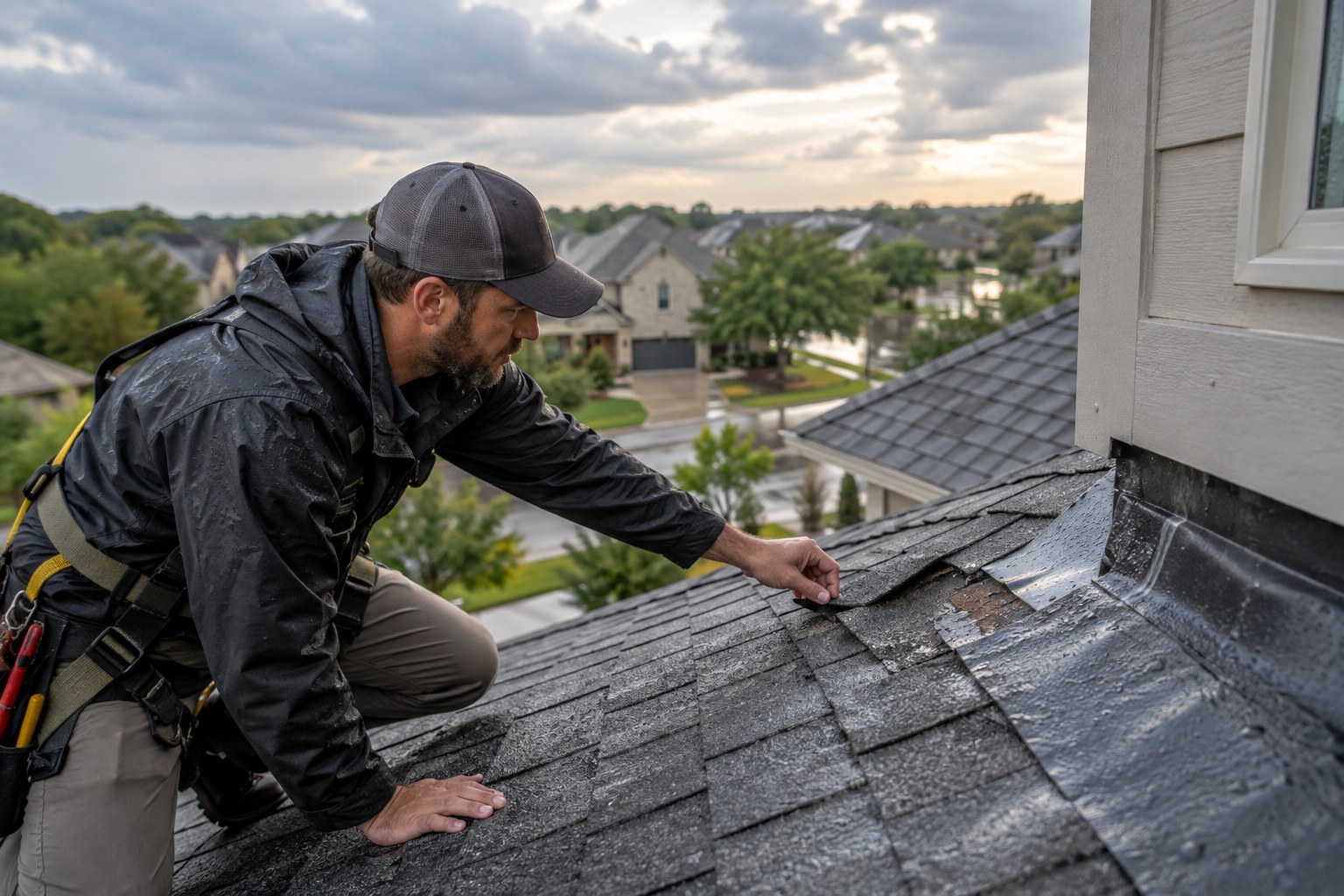
Each produces a different leak signature. A debris-packed valley leaks during long, steady rainfall. A shaded slope shows deterioration in the underlayment and decking before anything looks wrong from the ground. Limb contact leaks only when wind pushes rain from one direction. Reading the signature correctly is what prevents a sealant patch being applied to a drainage problem.
Water rarely enters directly above where it appears. On a pitched roof it can travel down the underside of the decking, along a rafter, or across the top of the ceiling insulation before it finds a seam, a fastener or a light fixture to drip through. On a low-slope commercial roof it can move laterally between the membrane and the deck for a considerable distance.
The practical method is to work uphill from the stain, identify every roof detail on that drainage path, and then establish which of them could plausibly pass water given the roof material, the slope and the rainfall that triggered the leak.
On Nacogdoches properties that usually means examining valley linings and the debris sitting in them, step and counterflashing at wall transitions, plumbing vent boots, attic and ridge ventilation, skylight curbs, chimney saddles, and the eave and rake edges where backed-up water can reverse direction.
The oldest residential stock near the downtown square and the courthouse includes steep-pitched roofs with complex intersections, dormers, additions and multiple valleys. Complexity is the risk factor on these: every intersection is a flashing detail, and older roofs often carry layers of previous repairs that obscure the original water path.
Around the Stephen F. Austin State University campus the mix shifts toward rental houses, duplexes and small multi-unit buildings. These roofs tend to be simpler but harder to inspect at the right moment, and interior damage is often reported late because the occupant is not the owner.
Along the US 59 and Loop 224 corridors, and around the medical and retail properties serving the wider county, low-slope and metal roofs dominate. Here the leak sources are membrane seams, rooftop equipment curbs, drains and scuppers, and exposed-fastener panel details rather than shingles and valleys.
The same stain means different things on different roofs. Identifying the assembly is the first step, because it determines which details can realistically pass water.
The dominant residential covering. Under canopy the critical checks are valley condition, seal-bond integrity after limb contact, and whether shaded slopes stayed wet long enough to affect the underlayment.
Common on rural outbuildings, agricultural structures and newer homes. Exposed fasteners back out as panels expand and contract, and seams and penetration flashing move with them.
Found on retail, office, institutional and medical buildings. Seams, patches around rooftop units, drain bowls and parapet flashing carry most of the risk.
Pipe boots, vents, skylights and chimneys interrupt the roof plane. Rubber boots harden and split in the heat, one of the most frequent single-point leak causes in Texas.
Nacogdoches is the seat of Nacogdoches County in deep East Texas, served by ZIP codes 75961, 75964 and 75965, with 75962 covering the Stephen F. Austin State University campus. The city sits where US 59 and State Highway 21 cross, with Loop 224 carrying traffic around the built-up area and US 259 and State Highway 7 extending into the surrounding county. The telephone area code is 936.
US 59 is the main north–south route through the county and is being developed as part of the future Interstate 69 corridor. State Highway 21 crosses it east to west, and Loop 224 rings the city.
Those corridors carry most of the local commercial and retail roof stock, which is where low-slope membranes and metal roofs are concentrated rather than shingles.
Lake Nacogdoches lies west of the city and Lake Kurth to the south, with the Neches River forming part of the county boundary. Nacogdoches County is bordered by Angelina, Cherokee, Rusk, San Augustine and Shelby counties.
Wooded, rolling terrain means many properties sit on lots with substantial tree cover directly over the roof plane.
The Nacogdoches County Courthouse and the surrounding historic downtown anchor the older building stock. The SFA campus, the medical facilities and the retail corridors add institutional and commercial roof types.
The result is an unusually mixed inventory for a city of this size: steep historic residential roofs and flat commercial membranes within a few blocks of each other.
Local geography narrows the search but does not finish it. Roof material, slope, assembly age, drainage condition and the weather that preceded the leak still decide what gets inspected first.
The order matters. Checking the obvious penetrations first and the drainage path last tends to produce repeat leaks, because on a shaded, debris-loaded roof the drainage path is the more likely culprit.
Steady rain, wind-driven rain, or only after prolonged rainfall. Each points to a different family of causes, and this single detail removes a large share of the possibilities before anyone is on the roof.
Valleys, gutters, scuppers and drains are examined for debris and for evidence of water having stood or reversed direction. Staining on the underside of the eave is often the clearest record of a backup.
Pipe boots, vents, skylight curbs, chimney saddles and roof-to-wall flashing are checked for splitting, lifted edges and displaced step flashing.
Attic access, where available, lets the wet path be traced on the decking and rafters. This separates the entry point from where water became visible.
A blocked valley needs drainage restored and its lining assessed; a split boot needs replacing; a wet deck section needs its moisture extent established before anything is covered over.
Most Nacogdoches calls resolve into one of a few specific problems. These are the service pages that explain how each is approached.
Appropriate when water is clearly entering but the canopy, the roof complexity or lateral travel inside the assembly has hidden the source. How roof leak detection works.
The most locally relevant sub-service, given how much debris the pine canopy delivers into valley lines every year. How valley leak repair works.
Relevant where limb contact, wind or age has broken seal bonds, cracked tabs or exposed fasteners and underlayment. How shingle leak repair works.
For the low-slope membrane and metal roofs along the US 59 and Loop 224 corridors, where seams, curbs and drains carry the risk. How commercial leak repair works.
Dense pine canopy drops needles continuously, and valleys are where that debris collects first. A packed valley slows runoff, holds moisture against the metal or shingle lining and lets water work sideways under the courses instead of draining off the roof. It is one of the few leak patterns that gets worse without any storm at all.
Yes, and it is common. Debris-blocked valleys, clogged gutters backing water up under the eave courses, and boots or flashing that have dried out in the heat can all leak during ordinary steady rain. If the stain shows up in a long soaking rain rather than a squall, the cause is often drainage rather than impact damage.
It makes them slower to reveal themselves. North-facing and heavily shaded slopes dry far more slowly after rain, so organic growth, softened decking and deteriorated underlayment can develop without the obvious curling or granule loss you would see on a sun-baked slope. The roof can look serviceable from the ground and still have a wet assembly.
It should. Limb impact frequently bruises shingles, breaks seal bonds, loosens fasteners or cracks a pipe boot without puncturing anything. Those defects leak selectively, often only when rain arrives with wind from a particular direction, which is why the connection to the original impact is easy to miss weeks later.
The roof work is the same, but access and timing usually are not. Multi-unit and rental buildings often need the leak traced while tenants are in place, and interior staining in one unit may originate above a neighbouring unit. Establishing the actual entry point before opening any ceiling matters more on those buildings than on a single-family roof.
Lufkin is the nearest of these, roughly twenty miles south on US 59.
Angelina County, about twenty miles south on the US 59 corridor.
Anderson County, north-west of Nacogdoches at the US 79 and US 287 crossing.
Harrison County, roughly seventy-six miles north on the I-20 corridor.
Gregg County, elsewhere in the East Texas service region.
Describe the roof type, where the water is showing and whether it appears in steady rain or only in wind-driven rain. That narrows the likely cause before anyone goes up.
Call Now · (844) 625-7943