
Historic residential
Victorian and early twentieth century houses with steep pitches, multiple gables, dormers and masonry chimneys. Complexity is the risk factor, and flashing junctions carry most of the leaks.
Marshall was founded in 1841 and its building stock shows it. The historic district around the Harrison County Courthouse, the Victorian and railroad-era houses on the surrounding streets, and the parapet-fronted commercial blocks downtown all leak in ways that newer construction does not.
On a building like that, the roof covering is rarely the whole story. The junctions, the flashing and the drainage built into the structure usually matter more.
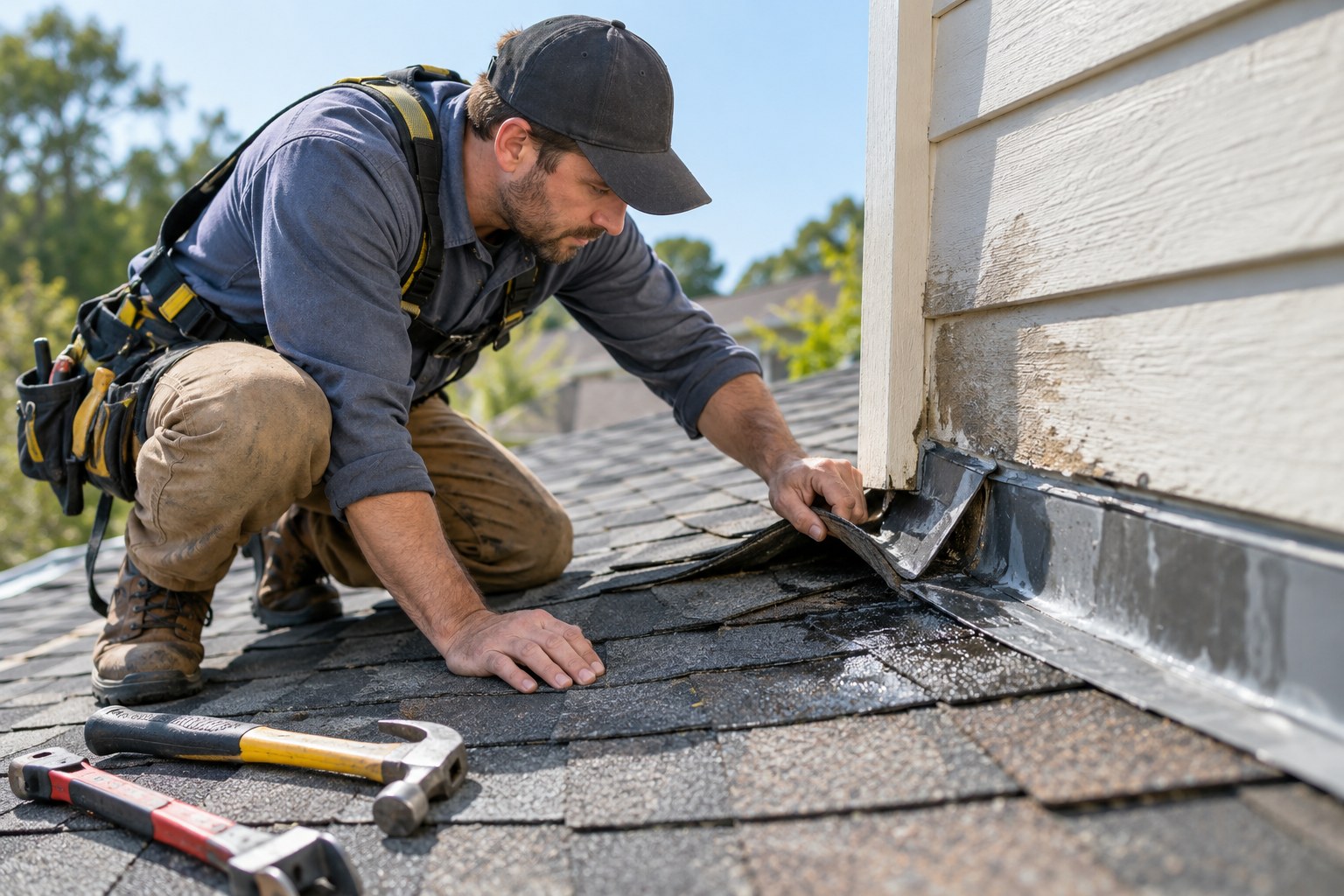
On a pre-war Marshall roof, start at the junctions: chimney flashing, roof-to-wall transitions, dormer cheeks, porch roof connections and any point where an addition meets the original structure.
A simple modern roof is a large field surface with a handful of penetrations. An older Marshall roof is frequently the opposite: many small planes, several changes of pitch, dormers, porch and bay roofs, additions built decades apart, and one or more masonry chimney stacks passing through.
Each of those is a junction, and junctions do not rely on the roofing material to stay watertight. They rely on metal flashing being correctly shaped, correctly lapped and correctly sequenced with the courses around it. When a roof like this leaks, the probability that the cause is a junction rather than the field is high.
The second factor is what has already been done to the building. A roof that has been recovered two or three times may have flashing that was reused, partially replaced, sealed over with mastic, or buried under a newer layer. Previous repairs are part of the diagnosis, not a distraction from it.
A masonry chimney passing through a sloped roof is one of the hardest details in residential construction to get right, and one of the most common sources of a persistent leak. It needs step flashing up both sides, counterflashing let into the mortar joints rather than surface-sealed, and on the upslope side a cricket or saddle to divert water around the stack instead of letting it pond against the brick.
Roof-to-wall transitions work on the same principle. Where a lower roof meets a vertical wall, step flashing has to be woven into the roofing courses and covered by counterflashing or the wall cladding above. If that sequence is wrong, water driven against the wall runs behind the metal and into the structure.
These details also explain why sealant is a poor long-term answer on an older house. A bead of mastic over a badly sequenced flashing hides the symptom for a season or two and then fails, usually leaving the underlying problem harder to read than before.
The Marshall Historic District is centred on the Harrison County Courthouse on the downtown square, and the commercial blocks around it are typical of nineteenth and early twentieth century Texas construction: masonry party walls, flat or near-flat roofs, and parapet walls fronting the street.
That configuration concentrates the leak risk in three places. The base flashing, where the roof membrane turns up the inside face of the parapet, is under constant stress from building movement. The coping on top of the wall is the building’s most weather-exposed horizontal surface and the one most often neglected. And because there is no eave, drainage is through internal drains or scuppers cut through the parapet, which means a blockage has nowhere harmless to overflow.
Party walls add a further complication. On a terrace of connected buildings, water entering at or near a shared wall can appear inside the neighbouring property, and the roof that needs the work is not always the roof under the stain.
Marshall holds three quite different roof inventories within a few miles, and each needs a different first question.
Victorian and early twentieth century houses with steep pitches, multiple gables, dormers and masonry chimneys. Complexity is the risk factor, and flashing junctions carry most of the leaks.
Low-slope roofs behind parapet walls on the square and surrounding blocks. Base flashing, coping and internal or scupper drainage are the priorities, along with party-wall conditions.
Retail, lodging and light commercial along the East End Boulevard stretch of US 59 and around the Interstate 20 interchanges, where conventional low-slope membranes and metal roofs dominate.
Marshall is the seat of Harrison County in north-east Texas, served by ZIP codes 75670 and 75672, with area code 903. Interstate 20 and US 59 cross here, US 80 runs through the city, and State Highways 43 and 154 extend into the surrounding county along with a network of farm-to-market roads. Jefferson lies about sixteen miles north and Nacogdoches roughly seventy-six miles south.
Interstate 20 passes along the south side of the city with US 59 crossing it, and East End Boulevard carries US 59 through the commercial strip. US 80 follows the older east–west alignment.
The commercial and lodging roof stock concentrates around the I-20 and US 59 junctions; the historic inventory sits north and west of it around the square.
Marshall grew as a Texas and Pacific railroad town, and the surviving depot and hotel buildings on North Washington Avenue are part of that legacy. Railroad-era commercial architecture means masonry walls, parapets and low-slope roofs.
The city is sometimes described as the cultural capital of East Texas, and Wiley College and East Texas Baptist University add institutional buildings to the mix.
Harrison County is in the Piney Woods, with the Caddo Lake area and the community of Karnack to the north-east and Scottsville east of the city. Humidity is high for much of the year.
That climate matters for masonry buildings in particular, because a wet wall assembly here dries slowly.
Building age is a useful starting assumption in Marshall but not a conclusion. The actual roof covering, the condition of each junction, the state of the drainage and the history of previous repairs still decide what gets inspected first.
Marshall’s mix spans two centuries of construction, and the assembly determines which details can realistically be passing water.
The most common covering on both historic and modern houses. On complex older roofs the critical areas are valleys and every flashing junction rather than the open slopes.
On downtown commercial buildings and corridor retail. Base flashing at parapets, coping, seams and internal drainage carry the risk.
Found on outbuildings, agricultural structures and some residential roofs across the county. Fasteners, laps and penetration flashing move with temperature.
Box and built-in gutters on older buildings sit within the structure rather than outside it, so a failure discharges into the building instead of down the wall.
The most locally relevant service, given how much of the older building stock leaks at a junction rather than in the roof field. How flashing repair works.
For the masonry stacks on historic houses, where counterflashing and the upslope cricket are the usual points of failure. How chimney leak repair works.
For parapet-walled buildings on and around the downtown square and the corridor retail along US 59. How commercial leak repair works.
Appropriate on an older building where previous repairs have made the original water path difficult to read. How roof leak inspection works.
Because older houses have more flashing. A home built in several phases over decades accumulates additions, dormers, porch roofs and chimney stacks, and every one of those creates a junction where two roof planes or a roof and a wall meet. Those junctions depend on correctly lapped metal rather than on the roofing material itself, and metal that has been disturbed, painted over or replaced out of sequence stops working.
A parapet is the section of exterior wall that continues above the roof line, which is why many older commercial buildings present a flat front with no visible roof. The roof behind it is low-slope, and the membrane has to turn up the inside face of that wall and terminate. That turn-up, and the coping that caps the wall above it, are among the most common entry points on a building of this type.
Repointing addresses the mortar between the bricks, not the connection between the chimney and the roof. If the counterflashing was never let properly into a mortar joint, or the cricket that should divert water around the upslope side of the chimney is missing or undersized, water will keep arriving at the same place regardless of how good the brickwork is.
Yes, and that is the main reason to treat leaks on older buildings as urgent. Water that gets behind a brick wall saturates the masonry and the mortar, and repeated wetting and drying degrades soft historic mortar faster than it degrades the brick. The visible ceiling stain is usually the least expensive part of the problem.
It does. A built-in gutter is part of the roof structure rather than something hung off the fascia, so when it fails the water goes directly into the building envelope instead of down the outside wall. These need their linings and outlets inspected specifically, and they are easy to miss if the inspection only covers the roof field.
Roof leak service covers the wider north-east and deep East Texas region.
Gregg County, west along the Interstate 20 corridor.
Nacogdoches County, about seventy-six miles south on US 59.
Bowie County, north of Marshall near the Arkansas line.
Smith County, west of Marshall in East Texas.
On an older building the most useful details are the approximate age, whether there is a chimney or an addition near the stain, and what has been repaired before.
Call Now · (844) 625-7943