Texas roof leak detection & repairRichardson, TX · (844) 625-7943
East Texas · Angelina County service area

Roof Leak Repair in Lufkin, TX

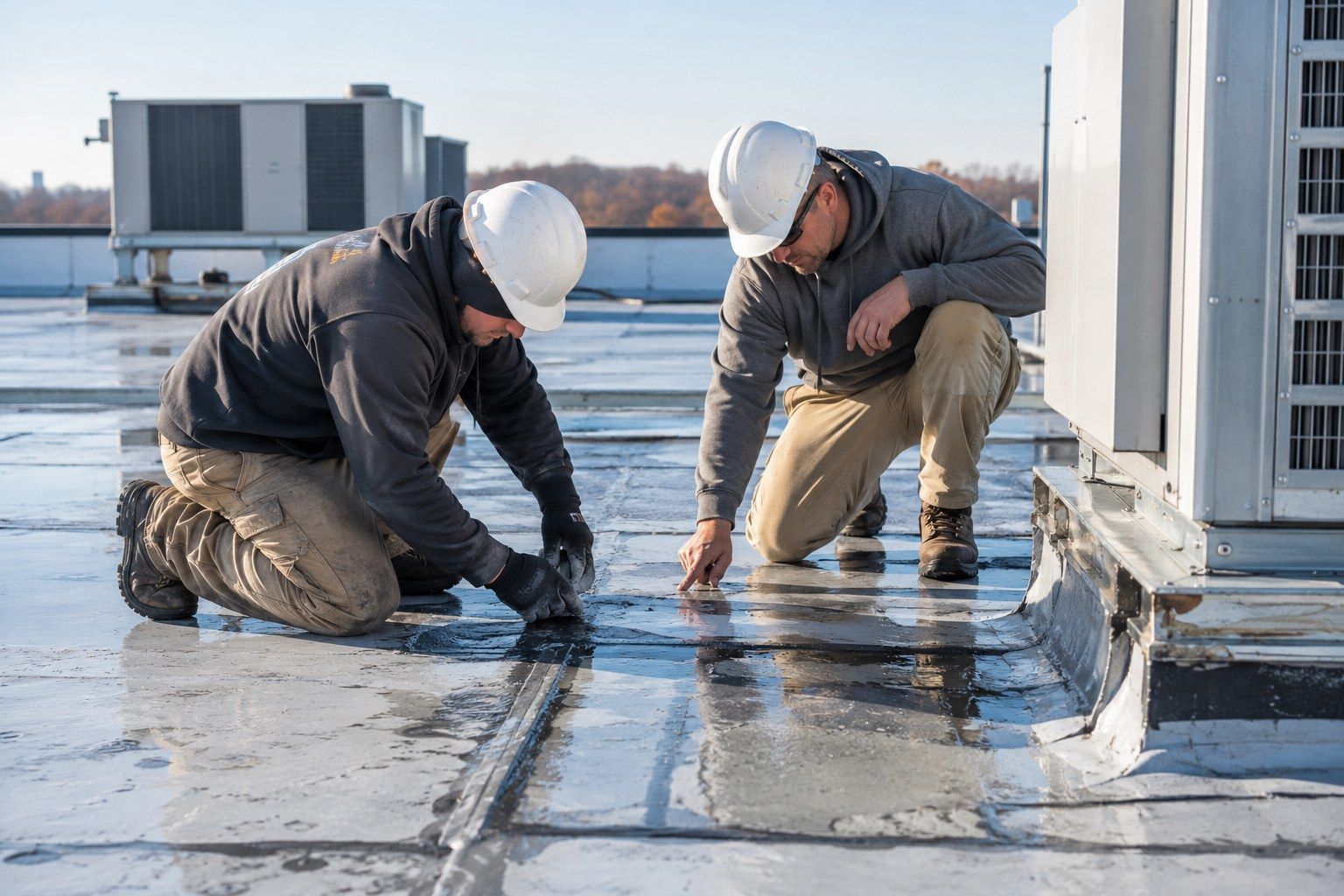
Lufkin carries a heavier share of low-slope commercial and industrial roofing than most East Texas cities its size, and low-slope roofs fail differently from pitched ones. They do not shed water; they drain it, and anything that interrupts drainage becomes a leak.

Whether the roof is a membrane over a warehouse, metal panels on a shop building or shingles on a house off Loop 287, the first task is the same: establish how water is reaching the inside.

Call (844) 625-7943

Commercial roof leak repair service in Lufkin, Texas
Low-slope specialismMembrane, metal and shingle systems
Drainage-first diagnosisPonding, drains and seams assessed before patching
Service area pageStatewide service, not a branch office claim
Local corridorsUS 59, US 69, SH 103, SH 94 and Loop 287
Drainage, not shedding

Why a low-slope roof leaks when a pitched roof would not

A pitched roof moves water off the surface in seconds. A low-slope roof holds it briefly and routes it to drains, scuppers or gutters. That matters because a seam, patch or flashing detail that performs adequately under fast-moving runoff may not hold against water standing on it for hours.

It also changes where the defect can be. Water entering a low-slope membrane at one point can travel a long way between the membrane and the deck before it appears inside, so the interior drip and the actual breach can be far apart.

The inspection therefore starts with the drainage system and the places water is held longest: drain bowls and strainers, scuppers, low spots and deck sags, the upslope side of equipment curbs, and the base flashing where the membrane turns up a parapet.

Low-slope warning signs

  • Water still standing more than a day or two after rain
  • Staining or rust tracking down from a deck seam inside
  • Blistering, ridging or soft spots underfoot on the membrane
  • Debris or gravel accumulated behind a curb or at a drain
  • Open or lifted seams, especially at patches and repairs
  • Separated or loose edge metal and coping after high wind
Commercial and industrial roofs

The Loop 287 corridor and the buildings on it

Loop 287 rings Lufkin and carries US 59, US 69 and State Highway 103 around the city, and that corridor concentrates much of the local commercial and light-industrial building stock — which is where low-slope membranes, large metal roofs and rooftop mechanical equipment are found.

Large roof areas change the problem. A warehouse or plant roof may cover tens of thousands of square feet with dozens of penetrations: exhaust fans, make-up air units, condensers, conduit supports, roof hatches and vent stacks. Each is a flashed interruption in the field membrane that moves as the building and equipment expand and contract.

Angelina County has a long association with timber and wood products, and processing buildings bring their own conditions: exhaust residue on the membrane, high interior humidity loading the underside of the deck, and foot traffic across the roof surface.

Humidity and the roof assembly

Separating a leak from condensation in a humid climate

Deep East Texas is humid for much of the year, and that creates a diagnostic trap. Not every drip from a ceiling is a roof leak. Warm, moisture-laden air reaching a cool surface inside an attic, above a suspended ceiling or on the underside of a metal deck will condense, and the result behaves enough like a leak to be mistaken for one.

The distinction is straightforward once the pattern is examined. A roof leak correlates with rainfall: it starts during or shortly after rain and stops when the roof dries. Condensation correlates with temperature difference instead. It is often worst in cold weather, appears across a broad area rather than at a point, and can occur in a week with no rain at all.

Getting this wrong is expensive in both directions. Sealing a roof that was never leaking does not stop condensation, and treating a genuine leak as a ventilation problem leaves water in the assembly.

Diagnostic note: If the water appears when it is cold and dry rather than when it rains, the roof may not be the problem. Confirm the correlation with rainfall before specifying a repair.

Property types

Three building categories, three inspection priorities

Lufkin’s roof inventory spans ordinary houses to large-span industrial structures, and the method has to change with the assembly.

Residential roofs

Shingles dominate, and the local complication is tree cover. Valleys and gutter lines load with pine and hardwood debris, and shaded slopes dry slowly. Pipe boots, step flashing and chimney transitions account for most single-point leaks.

Commercial and retail

Low-slope membranes over offices, retail and institutional buildings. Priorities are drainage, seam integrity, base flashing at parapets, and the flashing around every rooftop unit and its supports.

Light industrial and agricultural

Large metal panel roofs and long-span structures. Fasteners and washers, panel end laps, ridge and eave closures and penetration flashing are the recurring sources rather than the panel field.

Lufkin geography

Highways, ZIP codes and the surrounding Angelina County area

Lufkin is the seat of Angelina County, served by ZIP codes 75901, 75902, 75903 and 75904, with area code 936. The city sits where US 59 and US 69 meet, and Loop 287 carries both routes plus State Highway 103 around the city. State Highway 94 runs west of town, and US 59 through Lufkin is being developed as part of the future Interstate 69 corridor.

Loop 287 and the highway network

Loop 287 is the organising feature of the city. It runs concurrently with US 69 across the north and east sides and with US 59 to the north and south, meeting State Highway 103 at its north-western corner.

Business routes follow the older alignments through the city centre, which is where the older commercial building stock and its low-slope roofs are concentrated.

Terrain and surroundings

The city is often described as the crossroads of the Piney Woods. The Neches River and the Angelina National Forest lie to the east, and Sam Rayburn Reservoir further out in the same direction.

Diboll lies south along US 59; Nacogdoches is roughly twenty miles north on the same highway.

Built environment

The Angelina County Courthouse anchors the civic centre, and the surrounding downtown includes older masonry buildings with low-slope roofs and parapet walls.

Parapet construction matters for leak diagnosis: base flashing where the membrane turns up the wall, and the coping on top of it, are among the most common entry points on a building of that type.

Knowing the corridor a building sits on is a reasonable predictor of its roof type, but not a substitute for inspecting it. Deck type, membrane age, drainage design, previous repairs and the weather that triggered the leak all still apply.

Roof system reference

Where leaks typically originate, by roof type

Which details carry the risk on each assembly common in Lufkin. The actual source still has to be confirmed on the building.

Roof systemMost common leak originsWhat the inspection prioritises
Low-slope membraneOpen seams, failed patches, drain and scupper flashing, parapet base flashing, equipment curbsDrainage performance, ponding areas, seam probing, every penetration
Exposed-fastener metalBacked-out fasteners and compressed washers, panel end laps, ridge and eave closuresFastener condition, lap integrity, penetration flashing, panel movement
Standing-seam metalPenetration flashing, seam terminations, eave and ridge details, pipe curbsTerminations rather than the seam run; anything fastened through the panel
Asphalt shinglePipe boots, step and counterflashing, valleys, wind-lifted courses, exposed fastenersValley and gutter debris, boot condition, flashing at wall and chimney transitions
Relevant services

Roof leak services available in Lufkin

Commercial roof leak repair in Lufkin

For the retail, office, institutional and industrial buildings along Loop 287 and the US 59 and US 69 corridors. How commercial leak repair works.

Flat roof leak repair in Lufkin

Where drainage, ponding, seams or equipment curbs on a low-slope membrane are the suspected cause. How flat roof leak repair works.

Metal roof leak repair in Lufkin

Relevant to the panel roofs on shop, warehouse and agricultural buildings across Angelina County. How metal roof leak repair works.

Roof leak detection in Lufkin

Useful on large roof areas where the interior drip and the actual breach are a long way apart. How roof leak detection works.

Scope of repair

A leak does not automatically mean a new roof

On a low-slope roof, a single open seam, a puncture under a service walkway, a failed drain flashing or a lifted curb flashing can often be repaired on an otherwise serviceable membrane. The deciding factor is the condition of the surrounding roof and whether moisture has already entered the insulation layer.

Broader work becomes the more defensible option when seams are failing in several places, the membrane has reached the end of its service life, insulation is saturated across a wide area, or the deck has deteriorated. Those are findings, not assumptions.

On wet insulation: water trapped in the insulation layer does not drain and does not dry on its own. Establishing how far it has spread is what determines whether a patch is a repair or a postponement.

Roof leak questions from Lufkin property owners

Why are flat roof leaks so common on Lufkin commercial buildings?

Low-slope roofs do not shed water, they drain it. Anything that interrupts drainage — a blocked drain, a crushed insulation board, a sagging deck bay, debris behind a curb — leaves water standing on the membrane. Standing water finds seams and patches that shed rain perfectly well, which is why a roof can be watertight in a shower and leak after a long rain.

My metal roof leaks but there are no holes in the panels. Where is it coming from?

Almost always a fastener, a seam or a penetration rather than the panel field. Exposed-fastener roofs move constantly with temperature, and that movement enlarges fastener holes and compresses the neoprene washers until they no longer seal. Panel end laps, ridge and eave closures and anything flashed through the panel are the next places to look.

Does the high humidity here cause problems that look like leaks?

It can. In a humid climate, warm moist air reaching a cold surface inside an attic or above a suspended ceiling will condense, and the resulting drip is easy to mistake for a roof leak. Condensation usually appears over a broad area, often worst in cold weather, and does not correlate with rainfall. A genuine leak tracks the rain.

How does a leak get traced on a large warehouse or plant roof?

By narrowing the search area rather than walking the whole roof equally. The interior drip location, deck direction, nearest drains and rooftop equipment layout usually confine the likely entry point to a manageable zone. Isolating that zone is most of the work.

Is ponding water always a defect?

Not necessarily, but water still standing long after rain has stopped is a problem regardless of why. Prolonged ponding adds weight, accelerates membrane ageing and keeps any marginal seam under constant pressure. The cause may be drainage design, a settled deck or a blocked outlet.

A storm went through and nothing looks damaged. Is an inspection still worthwhile?

On a low-slope roof, yes. Hail bruising on a membrane and wind-lifted edge metal often leave no signature visible from the ground, and the resulting leak may not appear until a later rain.

Other East Texas service areas

Roof leak service covers the surrounding East Texas region as well as Lufkin itself.

Commercial or residential roof leaking in Lufkin?

For a low-slope roof, the most useful details are where the water shows inside, how long it has been happening, and whether water stands on the roof after rain.

Call Now · (844) 625-7943