Texas roof leak detection & repairRichardson, TX · (844) 625-7943
Southeast Texas · Golden Triangle service area

Roof Leak Repair in Orange, TX

Orange is the easternmost city in Texas, on the Sabine River at the Louisiana line, and it has absorbed more significant tropical weather in recent decades than almost anywhere else in the state. Roofs here are not tested by average conditions.

That history matters for diagnosis. In this part of Texas a leak is far more often a wind-driven rain path or a storm-weakened detail than a simple worn-out roof covering.

Call (844) 625-7943

Storm damage roof leak repair service in Orange, Texas
Storm-weather contextWind-driven rain and tropical damage patterns
Extreme rainfallDrainage capacity assessed, not just roof surface
Service area pageStatewide service, not a branch office claim
Verified local detailReal ZIP codes, highways and adjacent communities
Local weather reality

Why wind direction explains most roof leaks in Orange

Most useful detail

Note the wind direction, and whether the leak came with a squall or with prolonged heavy rain. Those two facts eliminate a large share of possible causes before an inspection even begins.

The single most useful question on an Orange roof leak is not how old the roof is. It is which direction the wind was blowing when the water came in.

Water driven against a roof under wind pressure does not behave like water falling onto it. It travels up the slope rather than down it, gets pushed under shingle courses against gravity, works in behind step flashing and counterflashing, and finds its way through laps and terminations that are perfectly adequate in vertical rain. This is why a roof can perform flawlessly through months of ordinary showers and then leak heavily in a single squall.

Directionality is the diagnostic gift here. If a leak only appears with wind from the south or east, the exposed slopes and details facing that direction are where the inspection concentrates. A leak that appears regardless of direction is usually something else: a failed penetration, a drainage blockage, or a saturated assembly.

The second local factor is rainfall intensity. Stalled storm cells over the Interstate 10 corridor have produced accumulations of many inches in a few hours. Any part of the roof that depends on water leaving quickly is vulnerable under those conditions.

Storm history

A roof inventory shaped by repeated tropical weather

Orange sustained a direct hit from Hurricane Rita in 2005. Hurricane Ike caused widespread and severe damage across Orange County in September 2008, with a substantial storm surge that breached the city’s levees and travelled up the Neches River. Hurricane Harvey reached the city in August 2017, and Hurricane Laura followed in 2020. In March 2016, record Sabine River flooding affected the east side of Orange County.

That sequence has practical consequences for roofs that are still in service. Many have been repaired more than once, sometimes under time pressure, and layered or improvised repairs can obscure the original water path. Others carry damage that was never visible from the ground: broken seal bonds, loosened fasteners, lifted and resettled edge metal, and flashing that was disturbed but not displaced.

The result is that roof age alone is a poor predictor of condition in Orange. What matters is what the roof has been through, what was done about it afterwards, and whether the details that face the prevailing storm direction are still intact.

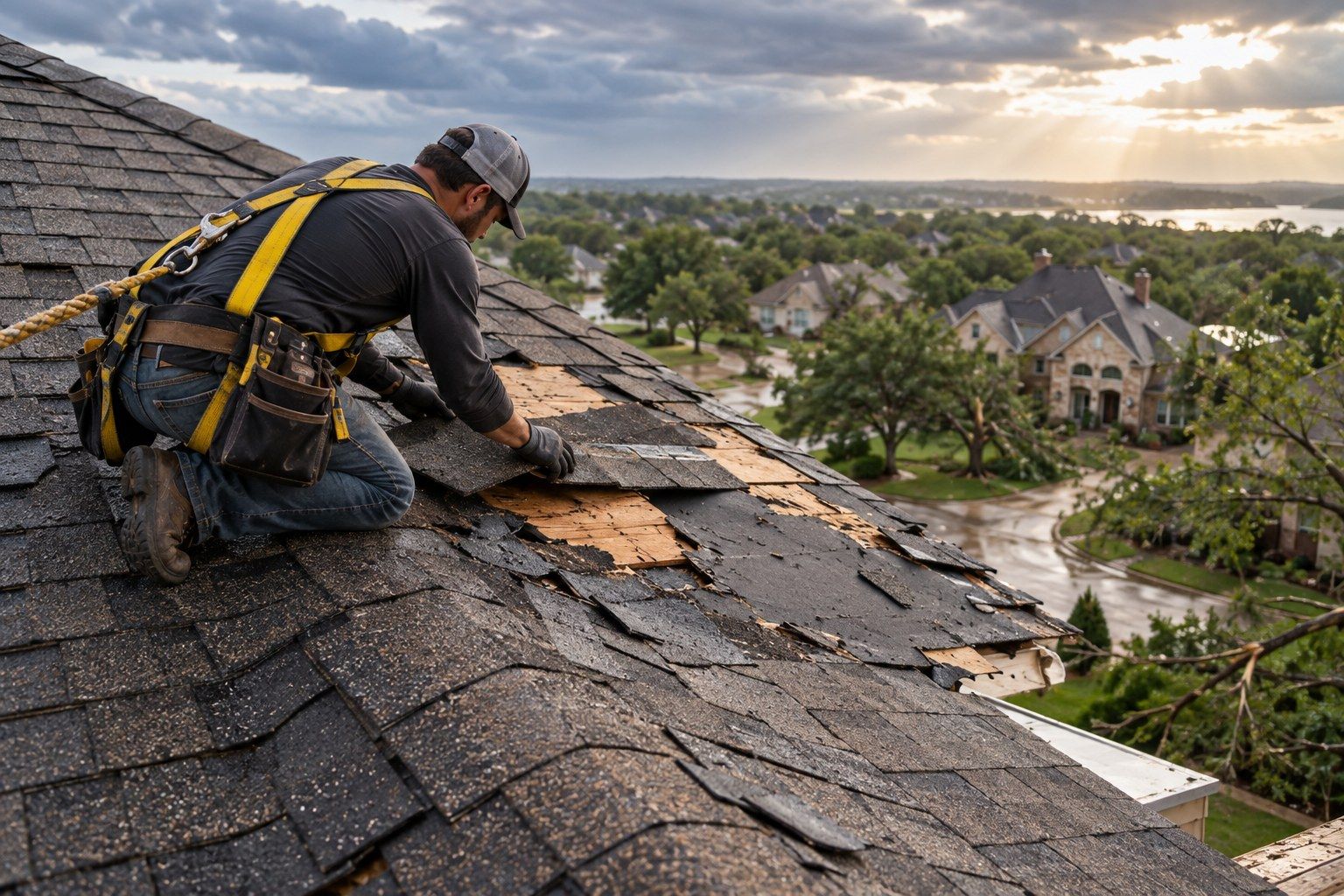
Roof leak repair after storm damage in Orange, Texas
Storm mechanics

What high wind actually does to a roof

Most storm-related roof leaks are not holes. They are intact-looking details that have lost the ability to resist water arriving under pressure.

Breaks seal bonds

Asphalt shingles rely on an adhesive strip bonding each course to the one below. Wind uplift can break that bond while leaving the shingle in place and looking normal. The course no longer resists water driven underneath it, so the roof leaks directionally and only in wind.

Lifts edges and terminations

Drip edge, rake metal, ridge caps, coping and the perimeter of a low-slope membrane take the highest uplift pressure on any roof. Once an edge has been lifted and settled back, the termination is compromised even though it may look continuous.

Disturbs flashing

Step flashing, counterflashing, chimney saddles and roof-to-wall details depend on overlap and position. Wind and debris can shift them slightly, which is enough to let driven rain in behind the metal rather than onto the roof surface.

Roof systems

Assemblies commonly evaluated in Orange

Each assembly has a different weak point under wind-driven rain, and the leak pattern inside usually points toward one of them.

Asphalt shingles

The dominant residential covering, and the one most affected by seal-bond failure. Checks focus on bond integrity, fastener condition, and the slopes facing the prevailing storm direction.

Metal panels

Common on homes, shops and outbuildings across Orange County. Fasteners, panel laps, ridge and eave closures and penetration flashing all move under wind load and thermal cycling.

Low-slope membranes

On commercial, industrial and institutional buildings near I-10 and the port and shipyard areas. Perimeter and edge terminations, drains and equipment curbs carry the wind and rainfall risk.

Soffits and transitions

Not the roof field, but a frequent entry point for driven rain. Vented soffits, roof-to-wall junctions and the area behind the drip edge are checked when water appears near an exterior wall.

Orange geography

The Sabine corridor, ZIP codes and nearby communities

Orange is the seat of Orange County, served by ZIP codes 77630 and 77632, with area code 409. Interstate 10 runs through the city and State Highway 87 carries north–south traffic. The Sabine River forms the Texas–Louisiana border immediately east of the city, and Orange has a deepwater port connection toward the Gulf.

Water on three sides of the problem

The Sabine River to the east, the Neches River to the west and the Gulf to the south all contribute. Releases from Toledo Bend Reservoir upstream have driven major Sabine flooding, and storm surge has historically travelled up the Neches as well.

For roofing, the relevant point is that heavy regional rainfall and tidal surge can coincide, which puts both the roof surface and its drainage under load at the same time.

Local areas and surroundings

Pinehurst and the area known locally as the Cove sit within the Orange area, and Bridge City, Rose City, Pine Forest, Vidor, Mauriceville and Deweyville lie in the surrounding county and nearby Newton County.

Orange County is bordered by Jefferson County to the west and by Newton County to the north, with Louisiana immediately east.

Built environment

The city grew substantially around shipbuilding, and the port, shipyard and refining presence along the river means a significant stock of industrial and commercial low-slope and metal roofing alongside the residential inventory.

Older residential areas include homes that predate current wind-resistance standards and have been through several named storms.

Geography explains the exposure but not the individual leak. The roof covering, its fastening, the condition of its terminations, the capacity of its drainage and the direction of the last storm still determine what gets inspected first.

After-storm sequence

How a storm-related leak is worked through

Order matters after a storm, because the most consequential defects are frequently the least visible ones.

Make the building safe and stop the ingress

Active water entry is addressed first with temporary protection where that is appropriate, before any diagnostic work. An open path admits every subsequent rain into the assembly.

Record the storm context

Date, approximate wind direction, whether hail was involved, and whether the leak appeared during the event or at the next rainfall. This is the single most useful input to the diagnosis.

Inspect the exposed slopes and terminations first

The slopes and details facing the storm direction, plus all perimeter edge metal, ridge and rake details, are examined for lifted, resettled or disturbed components.

Test the seal bonds and fasteners

Shingle courses are checked for broken adhesive bonds and backed-out or over-driven fasteners, which are the defects most likely to be missed from the ground.

Assess drainage capacity

Valleys, gutters, scuppers and drains are examined for blockage and for evidence of water having backed up.

Establish how far moisture has travelled

Decking, insulation and interior finishes are assessed so the repair addresses the wet extent, not only the entry point.

Relevant services

Roof leak services available in Orange

Storm damage roof leak repair in Orange

The most locally relevant service, given the city’s tropical weather history and the kind of damage high wind leaves behind. How storm damage repair works.

Emergency roof leak repair in Orange

When water is actively entering and the priority is stopping ingress before further rain reaches the assembly. How emergency leak repair works.

Roof flashing repair in Orange

Relevant where driven rain is getting in behind step flashing, counterflashing or a roof-to-wall transition rather than through the roof field. How flashing repair works.

Roof leak inspection in Orange

Appropriate after a named storm or severe thunderstorm when nothing obvious is visible but roof condition needs establishing. How roof leak inspection works.

Roof leak questions from Orange property owners

What is the difference between wind-driven rain and ordinary rain for a roof?

Ordinary rain falls onto the roof and runs off. Wind-driven rain arrives at an angle and under pressure, so it can be pushed uphill under shingle courses, sideways behind flashing, and through gaps that never see water in a vertical downpour. A roof can be entirely watertight in a normal shower and leak badly in a squall from one particular direction.

My roof came through a hurricane with no missing shingles. Why is it leaking now?

Wind can break the adhesive seal between shingle courses without displacing them. The shingles look correctly in place but no longer resist water being driven under them, and the leak only appears when the next storm arrives with wind from a similar direction. The same applies to flashing and edge metal that was lifted and then settled back down.

Does roof damage happen below hurricane-force wind?

Routinely. Edge metal, drip edge, ridge caps and flashing can be lifted well below hurricane thresholds, and severe thunderstorms in this area produce damaging gusts on their own. Damage is also cumulative: each event leaves the roof slightly less able to resist the next one.

Rain came in sideways through the soffit and the walls, not the roof. Is that a roof problem?

Sometimes, and it is worth establishing which. Wind-driven rain can enter at the roof-to-wall transition, behind the drip edge, through vented soffits or around wall penetrations, and the water then shows up inside in a way that looks like a ceiling leak. The entry point determines the repair, so the distinction matters.

How quickly should a storm leak be looked at?

Quickly, for two reasons. An open path lets every subsequent rain into the assembly, and in this climate a wet assembly stays wet. The other reason is practical: roof condition is far easier to document while the evidence is fresh than months later, after further weather has worked on it.

What should be checked after a long, very heavy rainfall rather than a windstorm?

Drainage first. Southeast Texas receives genuinely extreme rainfall rates, and high-intensity rain can overwhelm valleys, gutters, scuppers and drains that handle ordinary rain without difficulty. Water that backs up behind a blockage goes somewhere, and that somewhere is usually under the nearest course of roofing or behind the nearest flashing.

Other Southeast Texas service areas

Roof leak service covers the Golden Triangle and the wider Southeast Texas region.

Storm leak or active water entry in Orange?

The most useful things to describe are the wind direction during the event, whether hail was involved, and where inside the building the water is showing.

Call Now · (844) 625-7943