
Downtown and commercial
Oil-era masonry buildings around the centre and retail along US 259, where signage fixings, rooftop equipment and parapet details carry the risk.
Kilgore grew up around the East Texas oil field, and the city still carries the evidence: around sixty steel derrick replicas stand across the town, each topped with a star. It is a place where things get mounted, fastened and lit.
That habit shows up in the roofing. A high proportion of leaks here begin not with the roof wearing out but with something being attached to it, through it, or next to it.
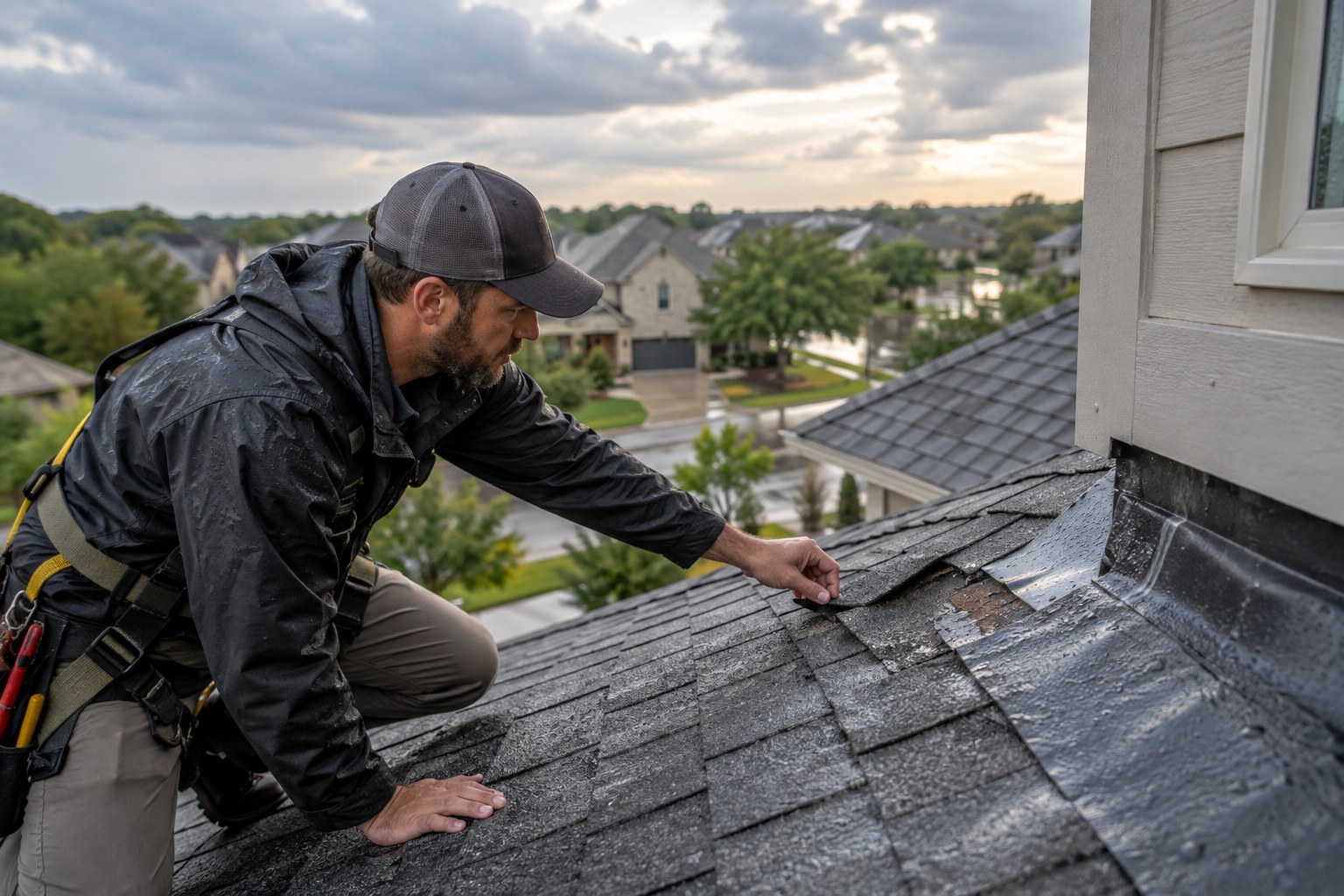
A roof is designed as a continuous surface with a known number of deliberate interruptions, each of which has a flashing detail worked out for it. Every later addition is an interruption nobody planned for, and the quality of its weatherproofing depends entirely on who installed it and what they knew about roofs.
The list is longer than most people expect: satellite and aerial mounts, signage and bracket fixings, security cameras, lightning protection, conduit and cable supports, condenser stands, handrails, decorative and seasonal lighting anchors, solar mounting rails, and the guy wires or stays for anything tall. None of these is installed by a roofer as a rule, and most are fastened down by someone whose job is the equipment, not the roof.
The failure is usually the same. The fixing is bedded in sealant rather than properly flashed. Sealant has a service life of a few years; the roof has a service life of decades. The installation looks finished, performs for two or three seasons, and then starts letting water in at a point nobody associates with roofing at all.
It is worth being precise about this, because the two are routinely treated as interchangeable and they are not.
Flashing is a shaped metal or membrane component that directs water around an obstruction and back onto the roof surface. It works by geometry and overlap: water meets it and is physically sent somewhere harmless. A correctly flashed penetration keeps working as long as the components stay in place, which on a decent roof means decades.
Sealant is a flexible compound that fills a gap and sticks to both sides of it. It works by adhesion, and adhesion is exactly what degrades under sun, heat and the daily expansion and contraction of whatever it is stuck to. In the East Texas climate, a bead of exposed sealant doing structural work on its own is good for a few years at best.
Sealant has a legitimate role as a secondary measure behind or alongside proper flashing. The problem is sealant used instead of flashing, which is how most added rooftop fixings are finished. Recognising that difference on a roof is often the whole diagnosis.
All three share the same local pattern: a disproportionate number of leaks trace back to something added after the roof went on.
Oil-era masonry buildings around the centre and retail along US 259, where signage fixings, rooftop equipment and parapet details carry the risk.
Petroleum service, workshop and light-industrial buildings, generally metal or low-slope, with a high density of equipment, conduit and stacks passing through the roof.
Houses across the city, predominantly shingle under East Texas pine cover, where valleys, pipe boots and added fixings such as aerials and lighting anchors feature.
The covering determines how badly an added fixing behaves, and how it should have been detailed in the first place.
Residential standard. Added fixings here often go straight through the covering into the decking, with the courses above never re-lapped over them.
On commercial and industrial buildings. A membrane tolerates a properly flashed curb indefinitely and a screwed-through bracket very poorly.
On shops, workshops and outbuildings. Fixing into a panel adds a fixed point to a surface that is constantly moving with temperature.
Vents, stacks, pipe boots and skylights that came with the roof, which still need checking before anything added is blamed.
Kilgore sits in southern Gregg County and extends south into Rusk County, with around three-quarters of the city in Gregg County. It is served by ZIP code 75662, with area codes 903 and 430. The city lies where Interstate 20 and US 259 converge south of the Sabine River, about four miles south of the interstate, and State Highways 31, 42 and 135 also serve it.
US 259 is the city’s main thoroughfare, with North Kilgore Street and North Henderson Boulevard carrying the business route. State Highway 31 connects east toward Marshall and west toward Tyler.
Kilgore lies roughly ten miles south-west of Longview and about 120 miles east of Dallas, with East Texas Regional Airport around sixteen miles away.
In the 1940s Kilgore had more than a thousand wooden derricks, and one downtown block became known as the World’s Richest Acre, now preserved as a park at Commerce and Main.
Around sixty steel derrick replicas stand across the city today, each topped with a star, which is the source of the city’s official nickname.
Kilgore College on Broadway Boulevard, the East Texas Oil Museum and the Rangerette Showcase are among the recognisable local institutions, with St. Luke’s United Methodist Church in the downtown core.
The city sits in the Piney Woods, so tree debris in valleys and gutters is a background factor on residential roofs here as across East Texas.
Knowing what has been added to a roof and when is frequently more useful in Kilgore than knowing how old the roof is, because the covering often outlives the detailing of everything fastened to it.
Useful when water is entering well away from where it appears, which is typical of leaks that begin at an added fixing. How roof leak detection works.
The core remedy where a penetration was sealed rather than properly flashed when it was installed. How flashing repair works.
For retail, industrial and petroleum service buildings carrying signage, equipment and conduit on the roof. How commercial leak repair works.
For panel roofs on shops and outbuildings, where every added fixing is a fixed point on a moving surface. How metal roof leak repair works.
Routinely, and it is one of the most under-recognised causes. Anything fastened through a roof makes a hole, and a hole only stays watertight if it is properly flashed rather than sealed. Satellite mounts, signage brackets, lightning protection, conduit supports, decorative lighting anchors and solar fixings all qualify. The roof was watertight until something was added to it.
Three things. Avoid fixings that penetrate the roof covering where a clamp or a weighted base would do. Do not fasten into flashing, edge metal or a seam, because those are the details holding the roof together. And remember that removal matters as much as installation — a screw pulled out in January leaves an open hole that is nobody’s job to close.
Because water moves before it appears. On a pitched roof it runs down the underside of the decking and along a rafter; on a low-slope roof it can travel between the membrane and the deck. The interior stain marks where water left the assembly, not where it got in, so an installation twenty feet uphill is entirely plausible as the source.
No, and this is the distinction that matters most. Sealant is a consumable that has a service life measured in a few years; flashing is a shaped, lapped component designed to shed water for as long as the roof lasts. A penetration that relies only on a bead of sealant is a scheduled future leak, not a finished detail.
They are worth hunting down. When a unit, aerial, sign or vent is taken off a roof, the fixings and the opening are often left behind and covered over rather than properly made good. Abandoned penetrations are a common source of leaks that nobody can explain, because the thing that caused them is no longer there to suggest the connection.
Roof leak service covers Gregg County and the surrounding East Texas region.
Gregg County, about ten miles north-east of Kilgore.
Smith County, west along State Highway 31.
Harrison County, east along State Highway 31 and Interstate 20.
Nacogdoches County, south of Kilgore in deep East Texas.
It helps to know whether anything has been fitted, serviced or removed from the roof in the last few years, and roughly where the water is showing inside.
Call Now · (844) 625-7943