
Established residential
Houses across the city and out toward the lake, predominantly shingle. Pipe boots, vent flashings and attic conditions are the recurring concerns.
Brownwood sits inland in Brown County, west of the Pecan Bayou, where summers are long and the sun is relentless. The components that fail first on a roof here are rarely the roof covering.
They are the small rubber, plastic and sealant parts around the penetrations — and how long those last depends a great deal on how hot the space underneath the roof gets.
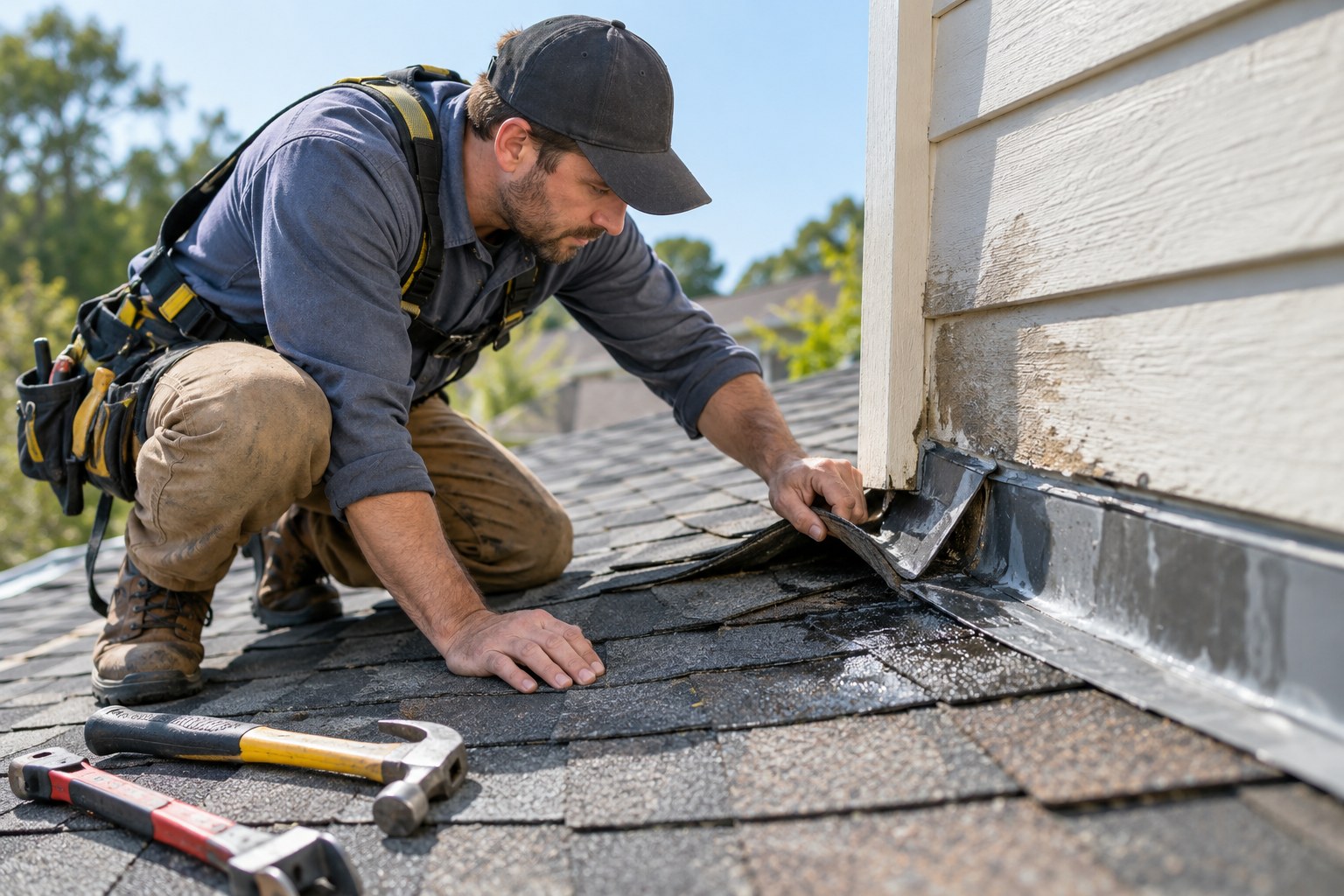
If the small components on a roof are failing early and repeatedly, the attic conditions above the ceiling are worth looking at. Replacing the boot again will not change why it failed.
A roof is usually treated as a surface: something on the outside of a building that either keeps water out or does not. On an inland Texas house in summer it is more useful to think of it as an assembly with a hot space underneath, because that space determines how quickly parts of the assembly wear out.
Sun on a dark roof surface produces temperatures well above the air temperature. If the attic below is poorly ventilated, that heat accumulates instead of being carried away, and the underside of the decking stays hot long after the sun has gone. Everything in between — the underlayment, the adhesives in the shingle seal strips, the sealants at flashings, and above all the rubber collars on the plumbing vents — is held at an elevated temperature for months at a time.
The result is not that the roof suddenly fails. It is that components with a finite heat tolerance get through their service lives faster. A pipe boot that might last a decade and a half in a mild climate with a well-ventilated attic can harden and split in a good deal less here, and when it does the water lands on a ceiling.
Attic ventilation is frequently thought of as a question of how many vents there are. It is better understood as airflow: cooler air entering low down and warmer air leaving high up, driven by the temperature difference and assisted by wind.
That means two halves. Intake comes in at the eaves, usually through soffit vents, and exhaust leaves near the ridge through ridge vents, static vents or turbines. Both have to be adequate, and they have to be proportionate to each other. Plenty of exhaust with blocked or absent intake does not move much air; it can instead draw air from inside the house, which is the opposite of helpful.
Two problems come up repeatedly. Insulation installed or blown to the edge of the attic smothers the soffit intake, so the system has no low-level supply. And different types of exhaust on the same roof plane can work against each other, with one pulling air in through the other instead of from the eaves. Neither is visible from the street, and both shorten the life of everything on the roof above.
The heat factor applies across all three, but it bites hardest where there is an occupied space directly beneath the roof.
Houses across the city and out toward the lake, predominantly shingle. Pipe boots, vent flashings and attic conditions are the recurring concerns.
Retail and commercial frontage along the US 67, 84, 183 and 377 corridors, plus institutional buildings, with low-slope membranes and rooftop equipment.
Rural properties and buildings out toward Lake Brownwood and the surrounding Brown County communities, including metal outbuildings and intermittently used structures.
These four account for a large share of residential leaks in a hot inland climate, and all four are affected by what is happening under the roof.
The most heat-exposed rubber on any roof, worked from above by sun and below by attic temperature. The single most common cause of a ceiling stain.
At flashing terminations and penetrations. They lose elasticity, then adhesion, well before the roofing around them is finished.
The adhesive bonding each course to the one below softens in extreme heat and loses grip over repeated cycles, leaving courses vulnerable to wind.
The secondary barrier beneath the covering. Sustained heat makes it brittle, so it no longer helps when the primary covering is breached.
Brownwood is the seat of Brown County, served by ZIP codes 76801 and 76802, with area code 325. Four US highways serve the city — US 67, US 84, US 183 and US 377 — along with State Highway 279. The city sits south of the centre of Brown County, west of the Pecan Bayou, and is bordered on the east by the city of Early.
US 84 and US 67 lead west toward Bangs and Santa Anna, and US 377 leads south-west toward Brady. All three head east into Early, where US 67 and US 377 continue north-east toward Comanche while US 84 leads south-east toward Goldthwaite.
Abilene lies roughly eighty-two miles north-west via US 84, and Fort Worth about 131 miles north-east via US 377.
Lake Brownwood lies around seven miles north of the city, with Lake Brownwood State Park reached from State Highway 279. Country Club Lake is the other significant local water body.
Brown County communities include Early, Bangs, Blanket, May, Zephyr and Brookesmith.
Howard Payne University, founded in 1889, is a defining local institution, along with Texas State Technical College. The Brown County Museum of History and the Martin and Francis Lehnis Railroad Museum are among the recognisable sites.
The Douglas MacArthur Academy of Freedom is affiliated with Howard Payne University.
The heat load here is a constant, but how much it shortens the life of a particular roof depends on the ventilation above that specific ceiling, which is why the attic is worth looking at.
For turbine, static and ridge vents, which are both part of the ventilation system and a potential leak source in their own right. How roof vent leak repair works.
The most frequent single cause of interior staining on local houses, and one of the most straightforward to resolve. How pipe boot repair works.
General residential leak work across the city’s shingle roof stock. How residential leak repair works.
Appropriate where small components keep failing early and the reason has not been established. How roof leak inspection works.
Indirectly but substantially. A poorly ventilated attic in an inland Texas summer gets extremely hot, and the roof assembly above it is cooked from both sides. That accelerates the ageing of everything with a limited heat tolerance — pipe boots, sealants, adhesives, underlayment — so the components that usually cause leaks reach the end of their lives sooner than they otherwise would.
Often nothing at all, which is the difficulty. The clues are usually inside: an attic that is uncomfortably hot well into the evening, decking that is darkened or has a scorched appearance, brittle or curling underlayment, and insulation that has been disturbed or compressed where it blocks the airflow at the eaves.
Yes, fairly often. Every vent is a hole in the roof with a flashing around it, and those flashings fail like any other. Turbine vents can seize or loosen on their bases, static vents corrode or crack, and ridge vents can be installed with their end closures left out. A vent is supposed to let air out, not water in, and the distinction depends entirely on its flashing.
Because they are the most exposed rubber component on the roof and they get it from both directions. Direct sun and ultraviolet degrade the collar from above while attic heat works on it from below. The material hardens, shrinks away from the pipe and splits, usually within a time frame well short of the roof covering’s own service life.
Not automatically. Ventilation works as a balanced system of intake low down and exhaust high up, and adding exhaust without adequate intake can simply pull conditioned air out of the house. Mixing different exhaust types on one roof plane can also cause them to short-circuit one another. It is worth assessing what is there before adding to it.
Roof leak service covers Brown County and the surrounding region.
Taylor County, about eighty-two miles north-west via US 84.
Nolan County, north-west of Brownwood in West Texas.
Erath County, north-east toward Fort Worth.
Tom Green County, west of Brownwood.
If this is not the first time the same small component has failed, mention that — it usually points at conditions in the attic rather than at the part itself.
Call Now · (844) 625-7943