
Exposed-fastener metal
The most common covering on shops, outbuildings and many commercial roofs, and the one most exposed to fatigue. Every screw is a fixed point being worked continuously.
Nolan County is the centre of the Texas wind industry, with well over a thousand turbines and some of the largest wind farms in the world. There is a reason they are here: the wind is not an event, it is a condition.
Roofs in a constant-wind environment fail by fatigue rather than by drama. Fasteners work loose, laps flex until their seals give, and edge metal cycles until something lets go — usually with no storm anyone can point to.
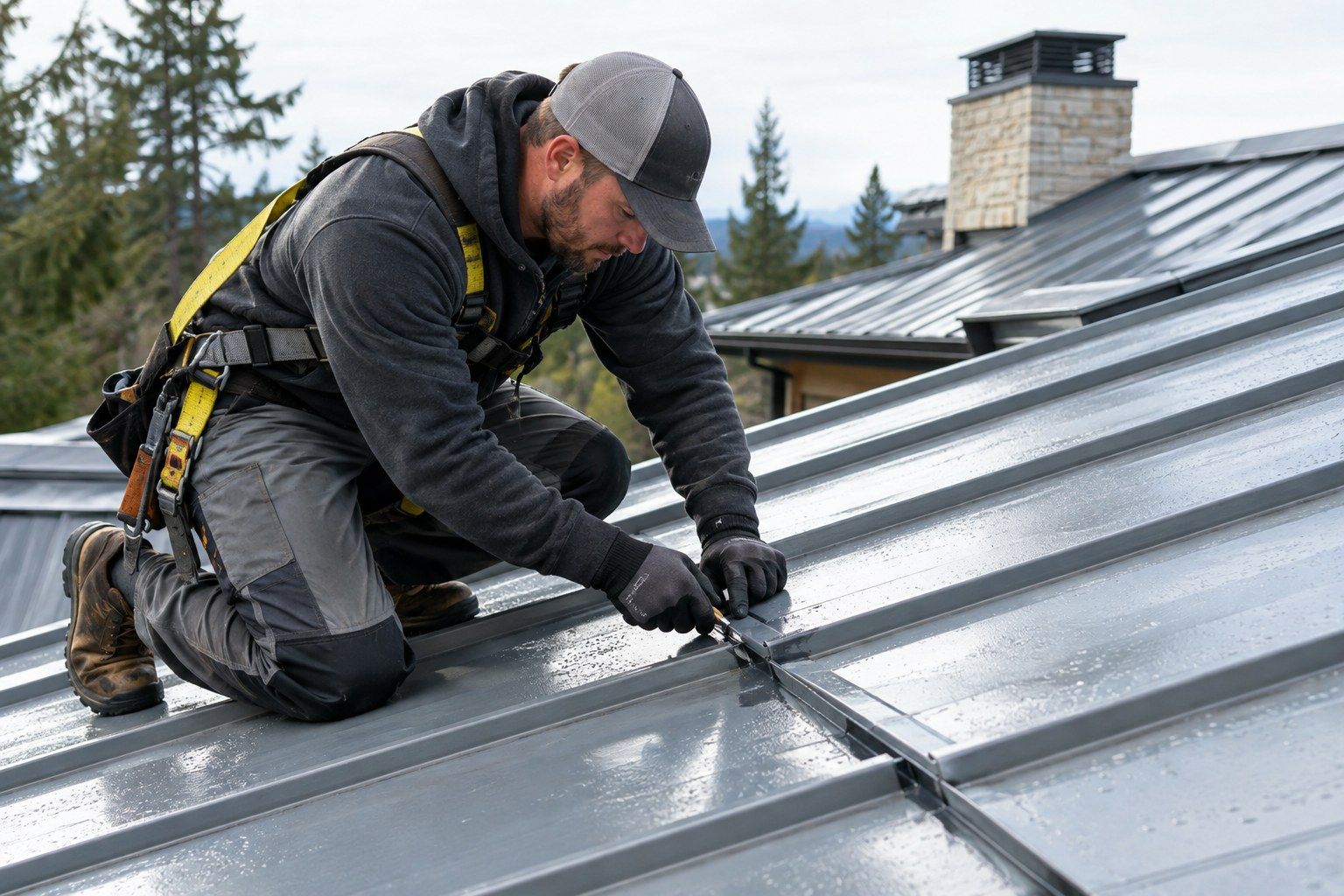
A roof here can reach the end of its serviceable life without a single memorable storm. Look for cumulative wear at fixings and edges, not for damage from one event.
Most roofing advice about wind is written around storms: a severe event arrives, applies a large load, and something breaks. That model works in most of Texas. It does not describe what happens on the Rolling Plains west of Abilene, where moderate to strong wind is the normal state of the atmosphere rather than an interruption to it.
The relevant mechanism here is fatigue. A component that would never fail under a single application of a given load will fail under enough repetitions of a smaller one. A fastener in a panel roof is worked every time the wind gusts and every time the temperature changes, and in this environment both happen constantly. Over years, the hole elongates, the washer hardens and compresses, and the fixing stops sealing.
The same applies to laps and terminations. A panel end lap flexes microscopically with every gust; the sealant between the sheets is asked to accommodate that movement indefinitely and eventually cannot. Edge metal and coping cycle until a cleat loosens. None of this produces a dramatic failure, which is exactly why it is so often missed until water appears.
The second thing a windy, semi-arid environment does to a roof is sand it. Air moving across open country picks up dust and fine grit, and anything standing in that stream is being lightly abraded whenever the wind blows — which is most of the time.
The layers that matter are thin. A metal panel’s performance depends on a factory-applied coating measured in thousandths of an inch; a low-slope membrane depends on its surfacing; an exposed sealant bead depends on a skin that is already its weakest part. None of these is thick enough to tolerate decades of scouring at a high-exposure point.
The pattern is predictable once you know to look for it. Abrasion concentrates on windward elevations, at ridges and edges where air accelerates, and around anything that creates turbulence — an equipment curb, a parapet, a projecting vent. Those are the places where coating loss, and then corrosion, starts. The sheltered side of the same roof can look years younger.
It is easy to assume that a dry climate is an easy one for roofs. It is not, because the rainfall that a semi-arid area does receive tends to arrive in concentrated convective storms rather than steady rain.
That creates a specific vulnerability. Drainage on a roof here may go months without being seriously tested, and during those months dust, grit and windblown debris accumulate in exactly the places water needs to move through: valleys, gutters, scuppers, drain bowls. Then a storm delivers more water in an hour than the previous quarter managed in total, and it meets a partially blocked path.
Water that cannot leave backs up, and backed-up water gets under roofing courses and behind flashing that were never designed to resist it from below. This is why a roof in a dry climate can be entirely sound across its field and still leak badly two or three times a year.
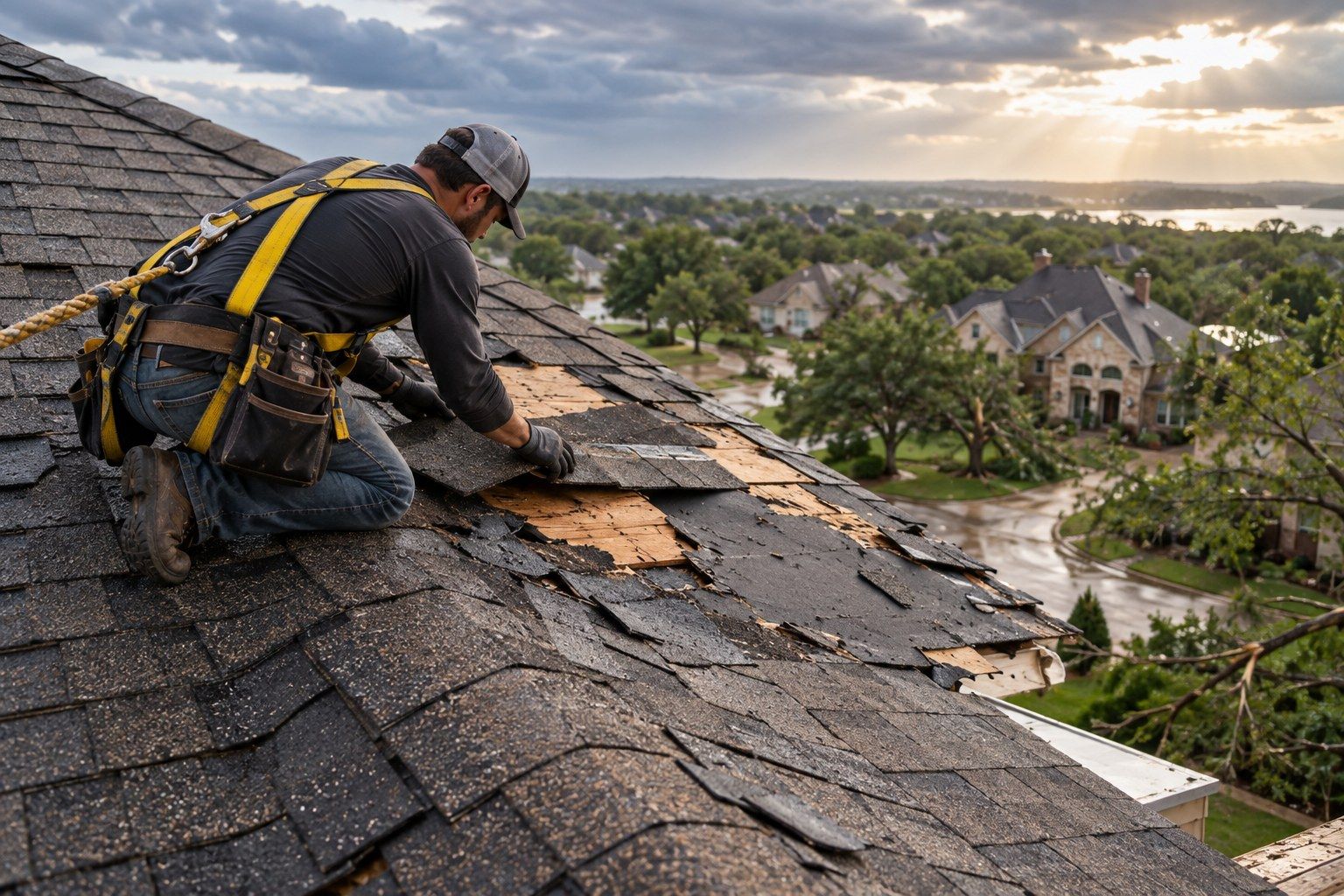
Each assembly has a different fatigue point, and on an exposed West Texas roof that point is almost always a fixing or an edge rather than a surface.
The most common covering on shops, outbuildings and many commercial roofs, and the one most exposed to fatigue. Every screw is a fixed point being worked continuously.
The panels float on clips, so the field handles movement well. Failures concentrate at terminations, closures and anything cut into the panel.
Residential stock. Perimeter seal bonds and ridge caps take the uplift, and granule loss to abrasion is worth checking on windward slopes.
On commercial buildings along Interstate 20. The perimeter termination and edge metal matter more here than anywhere in the field.
Sweetwater is the seat of Nolan County in West Texas, served by ZIP code 79556, with area code 325. Interstate 20 runs through the city along with US 84, State Highway 70 and FM 419. The city sits at an elevation of roughly 2,169 feet on the Rolling Plains.
Nolan County has over 1,400 turbines of a megawatt or larger and around 2,373 megawatts of developed wind capacity, including some of the largest wind farms in the world — Roscoe, Sweetwater and Buffalo Gap among them.
The county alone would rank among the larger wind-generating nations in the world, which is as direct an indication of the local wind resource as anything.
A tornado swept through the town early in the morning of 19 April 1986. Convective storms bring the area both its heaviest rainfall and its hail.
Open terrain means little shelter for buildings on the edges of town or out in the county.
The Nolan County Courthouse anchors the civic centre, and Avenger Field, formerly Sweetwater Army Airfield, lies on the edge of the city.
Lake Sweetwater, built in 1929, and Trammell Lake, built in 1914, provide the local surface water alongside the earlier town lake.
Exposure and roof type narrow the likely cause considerably here, but the condition of the fixings, laps, closures and coatings on the specific roof still determines where water is entering.
The most locally relevant service, given how much of the area’s roof area is panel metal working in constant wind. How metal roof leak repair works.
For edge metal, closures and terminations, which are where uplift concentrates on an exposed roof. How flashing repair works.
For the convective storms that bring the area its hail and its heaviest rainfall. How storm damage repair works.
Useful precisely because fatigue failures accumulate without a triggering event to prompt a look. How roof leak inspection works.
They damage differently. A storm applies a large load once and may break something outright. Constant wind applies a smaller load several million times, and that is a fatigue problem: fasteners work loose, laps flex until the sealant between them fails, edge metal cycles until a clip gives. A roof in a place like this can fail without any single memorable weather event.
It abrades. Wind-carried dust and sand scour exposed surfaces over the years, and the things that suffer most are the thin protective layers: factory coatings on metal panels, the surfacing on a low-slope membrane, and exposed sealant beads. Once a coating is worn through at a high-exposure point, corrosion has somewhere to start.
Because the rain that does come often arrives all at once. A semi-arid climate does not mean gentle rainfall; it means long dry spells punctuated by intense convective storms. Drainage that is never tested for months is suddenly asked to clear a lot of water quickly, and debris that has accumulated through the dry period is sitting in the way.
The perimeter and the fasteners. Uplift concentrates at edges and corners, and fatigue concentrates at every fixing. Between them those two account for most of what goes wrong locally, and both can be assessed without specialist equipment.
It does, and it tends to arrive with the same convective storms that bring the heavy rain. On metal, the thing to look at is whether hail struck something with a sealing function — a seam, a closure, a sealant bead, a fastener head — rather than how dented the panel field looks.
Not always. Sweetwater was struck by a tornado in April 1986, and events of that kind leave a gradient of damage rather than a clean edge. Buildings on the margins can lose seal bonds, shift edge metal or have flashing lifted and resettled without any of it being visible from the ground.
Roof leak service covers Nolan County and the wider West Texas region.
Taylor County, east along Interstate 20.
Howard County, west along Interstate 20.
Tom Green County, south of Sweetwater.
Brown County, south-east toward Central Texas.
If there was no obvious storm, that is useful information rather than a puzzle. Fatigue at fixings and edges is the usual answer here.
Call Now · (844) 625-7943