Town residential
Houses across Vernon, predominantly shingle. Pipe boots, valley and chimney flashing, and ice accumulation at eaves are the recurring concerns.
Vernon sits on the Rolling Plains a short distance from the Red River and the Oklahoma line, roughly 150 miles from Dallas–Fort Worth, Lubbock, Amarillo and Oklahoma City alike. It is genuinely in the middle of its own region.
The roofing consequence of that position is range. Summers are hot and winters bring real freezes, so every material on the roof travels further each year than it would nearer the coast — and it is the joints that pay for it.
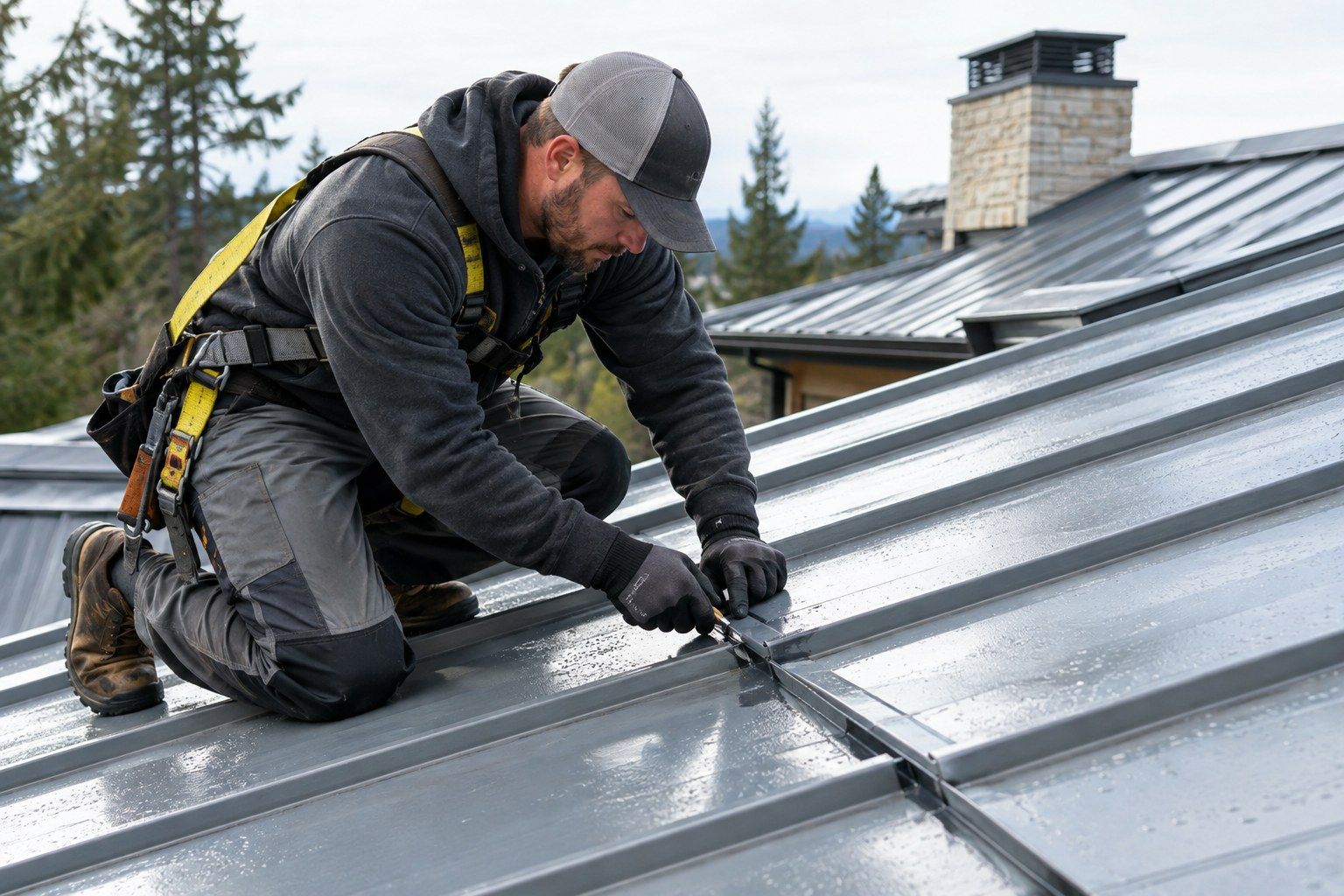
If a roof is leaking at joints and terminations with no storm to blame, thermal cycling is the likely driver. Look at the sealants, laps and fastener holes rather than the roof surface.
Every roofing material changes size with temperature. In a mild climate that movement is small enough to be absorbed by the normal tolerances of the assembly. The further the temperature swings, the less true that becomes.
Vernon experiences both ends. Summer heat on a dark roof surface produces temperatures well above air temperature, and winter brings hard freezes rather than the occasional mild cold snap. Across a year, the materials on a roof here travel through a considerably wider range than the same materials would on the Gulf Coast, and they do it twice every day on a smaller scale as well.
The field of a roof mostly handles this. Joints do not. A sealant bead has a movement capability it was designed around, and exceeding it repeatedly destroys the bond. A metal lap slides a little further each cycle until the sealant between the sheets has been worked to nothing. A fastener hole elongates. A flashing termination is pushed up and pulled down until it no longer sits tight. These are not storm failures and they have no event attached to them, which is why they tend to go unnoticed until water arrives.
A hard freeze is the one weather event that hides its own damage. For as long as temperatures stay below freezing, water cannot move, so even a compromised roof behaves exactly like an intact one. Nothing drips, nothing stains, and there is nothing to report.
Meanwhile several things are going on. Water sitting in a small opening expands as it freezes, widening that opening a little; repeated cycles widen it further. Ice building up in valleys, at eaves and around drains dams the drainage path, so when melt begins the water backs up and travels under courses and behind flashing that were never meant to resist water arriving from that direction. Sealants stiffen and crack. On flat roofs, accumulated ice and snow add real weight for days at a time.
Then the thaw arrives and all of it is released at once, through whatever opening the freeze created. The leak is reported as a thaw problem; the damage was done earlier, and in most cases the vulnerable detail was identifiable before winter started.
All three see the same temperature range, but metal buildings move the most and therefore show it soonest.
Houses across Vernon, predominantly shingle. Pipe boots, valley and chimney flashing, and ice accumulation at eaves are the recurring concerns.
Wheat, cotton and cattle operations across the county mean a large stock of long-span metal buildings, where thermal movement at fasteners and laps dominates and condensation is common in cold weather.
Frontage along US 287 and the US 183/283 corridor, plus civic and institutional buildings, with low-slope membranes and rooftop equipment.
The common thread is that failures concentrate where two things meet, because that is where differential movement has to be absorbed.
The agricultural standard. Fastener holes elongate with every cycle, and panel end laps work until the sealant between them has gone.
Designed to accommodate movement in the field, so the weak points are terminations, closures and anything fixed through the panel.
Residential stock. Seal bonds, pipe boots and flashing terminations take both the heat and the freeze.
On commercial buildings. Seams, drainage and parapet base flashing, with ice load an additional winter factor.
Vernon is the seat of Wilbarger County in the North Texas Rolling Plains, served by ZIP code 76384, with area code 940. Four US routes serve the city — US 70, US 183, US 283 and US 287 — meeting at the intersection of US 287 and US 183/283. The city lies about fifty miles north-west of Wichita Falls and roughly 150 miles from Dallas–Fort Worth, Lubbock, Amarillo and Oklahoma City.
US 287 runs through between Quanah to the north-west and Wichita Falls to the south-east. US 283 continues north toward Altus, Oklahoma, and US 70 runs east from Crowell.
Wilbarger County lies on the Red River, which forms the Oklahoma boundary to the north.
Land uses across Wilbarger County include wheat, cotton, alfalfa, peanuts, guar, mung beans and cattle, which is what puts so much long-span metal roofing on the local inventory.
The surrounding country is open, with a rugged red rock landscape in places and little natural shelter from wind.
The Wilbarger County Courthouse on Wilbarger Street dates from 1928. The Red River Valley Museum on College Drive sits near Vernon College on the north side of the city.
Doan’s Crossing lies about fifteen miles north on Highway 283 near Fargo, and the Santa Rosa Roundup rodeo is held south of town off Route 183. Lake Kemp and Copper Breaks State Park are within reach.
Building type is the strongest predictor here. A metal agricultural building and a shingled house in the same town are being worked by the same temperatures in quite different ways.
The most locally relevant service, given how much of the county’s roof area is long-span agricultural metal. How metal roof leak repair works.
For the terminations and laps where differential movement is absorbed, and where it eventually tells. How flashing repair works.
For active water entry during a thaw, when stopping ingress has to come before diagnosis. How emergency leak repair works.
Most useful before winter, when the details that fail in a freeze can still be reached and corrected cheaply. How roof leak inspection works.
Because the materials move further. A roof on the upper Texas coast works through a comparatively narrow band of temperatures. A roof on the Rolling Plains near the Red River sees genuine hard freezes in winter and extreme heat in summer, so every component expands and contracts across a much wider range every year. Anything joining two materials together has to absorb that difference, repeatedly.
The joints. Sealant beads that have to stretch and compress further than they were formulated for, metal laps that slide against each other until the seal between them is gone, fasteners whose holes elongate as the panel moves, and flashing terminations that are pushed and pulled until they lift. None of these is storm damage, and none of them has a date you can point to.
Nothing moves while it is frozen. Ice blocks the route, so the roof appears to be performing even where it has been damaged. When the thaw comes the blockage clears, the meltwater arrives all at once, and it finds whatever opening the freeze widened. The damage happened days before the leak was noticed.
Metal moves more than most roofing materials for a given temperature change, so a long panel run on an unheated agricultural building is working hard twice a day, every day. On top of that, the underside of an uninsulated panel is the coldest surface in the building, which makes condensation a frequent and easily misdiagnosed problem in cold weather.
Clear the drainage path completely, replace any sealant that is already cracked, and check that flashing and edge metal are properly secured. All three are modest jobs in mild weather and become urgent, expensive and weather-dependent once a freeze has arrived.
Roof leak service covers Wilbarger County and the surrounding Rolling Plains region.
Wichita County, about fifty miles south-east on US 287.
Potter and Randall counties, north-west of Vernon.
Lubbock County, west of Vernon on the South Plains.
Nolan County, south of Vernon in West Texas.
If the leak followed a thaw, note when it started relative to the freeze. If there was no weather event at all, say so — that points somewhere specific.
Call Now · (844) 625-7943