
Dairy and livestock buildings
Free-stall barns, milking facilities, feed storage and shelters, almost all long-span metal. Corrosion from the interior atmosphere is the dominant mechanism, concentrated at fasteners and cut edges.
Hopkins County has long been known as dairy country, and that matters for roofs in a way most roofing advice never covers. Livestock buildings corrode from the inside, not the outside.
A barn roof can present a perfectly respectable weather face and be failing at every fastener beneath it, because the moisture and ammonia in the air below have been working on the steel for years.
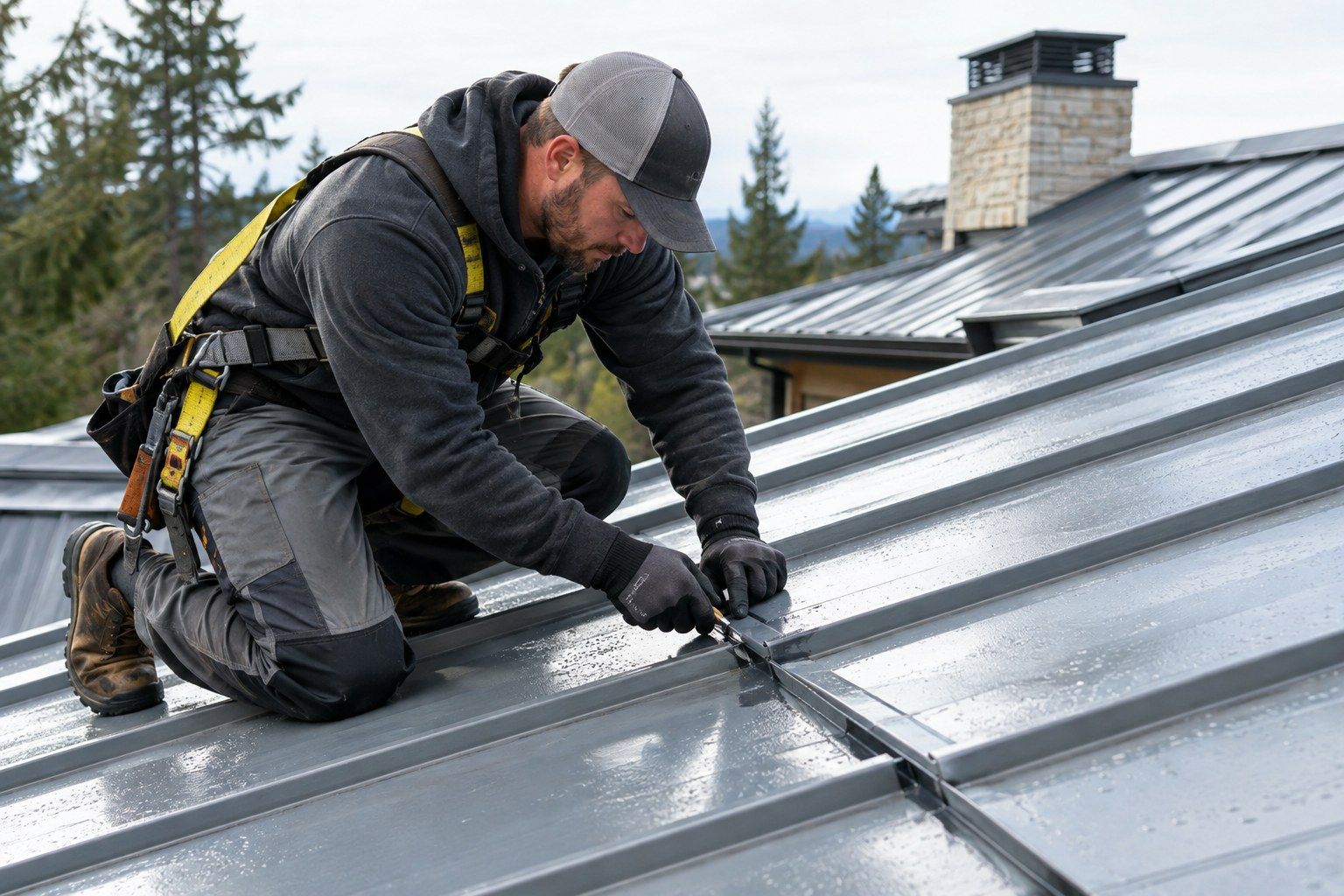
On any livestock or dairy building, inspect from underneath as well as from above. The fasteners and the panel underside tell you the real condition; the weather face tells you very little.
Almost every roof in Texas wears out from the top down. Sun, rain, hail and wind work on the exposed surface until something gives. Livestock buildings are one of the few cases where the opposite happens, and it catches people out because all the usual visual checks are aimed at the wrong face.
The mechanism is straightforward. Animal housing produces a continuous load of moisture and ammonia into the air. That warm, humid, mildly aggressive air rises and reaches the coldest surface in the building, which is the underside of the roof panel. There it condenses and sits, in contact with the steel, for long periods.
What suffers first is not the panel field but the details: the fastener shanks passing through the sheet, the cut edges at laps and openings, and the unprotected back face of the panel where the coating is thinnest. Each failed fastener becomes a hole, and each hole lets rain in from above while the corrosion continues from below. A roof in that condition can look entirely serviceable from the yard.
An exposed-fastener metal roof is held down by thousands of screws, each sealing its own hole with a small washer under the head. The roof is only as watertight as those seals, and they have a far shorter service life than the steel around them.
Three failure patterns account for most of it. Screws back out as the panel expands and contracts with temperature, lifting the washer clear. Screws driven too hard squeeze the washer out from under the head so it no longer seals. And screws corroding in a humid, ammonia-rich atmosphere lose the shank itself, so water runs straight down what is left of the thread.
Counting and categorising those failures across the roof is the single most informative thing that can be done on an agricultural building, and it also answers the repair-or-replace question. A handful of failures on a sound roof is a maintenance job. Several hundred, with rust streaking on the purlins below, is a different conversation.
The three groups fail by genuinely different mechanisms, so the same inspection method does not serve all of them.
Free-stall barns, milking facilities, feed storage and shelters, almost all long-span metal. Corrosion from the interior atmosphere is the dominant mechanism, concentrated at fasteners and cut edges.
Equipment sheds, workshops and hay storage without the livestock atmosphere. Here the drivers are thermal movement, fastener fatigue and panel end laps rather than chemical attack.
Residential streets and the commercial stock around the courthouse square and the Interstate 30 corridor, where low-slope membranes and shingles behave conventionally.
Because the problem originates in the air inside the building, part of the answer is about that air rather than about the roof covering. Where moist, ammonia-laden air is allowed to stagnate against the underside of a panel, corrosion continues no matter how good the replacement fasteners are.
Adequate ridge and eave ventilation, unobstructed airflow along the length of the building, and keeping ventilation openings clear all reduce how long that air sits in contact with the steel. On buildings where insulation has been added beneath the panel, the condition and continuity of any vapour control layer matters as well, because a gap in it concentrates moisture at exactly one point.
None of this removes the need to repair what has already failed. It does determine how long the repair lasts, which is why a sensible scope on an agricultural building looks at the ventilation alongside the roof rather than treating them as separate questions.
Sulphur Springs is the seat of Hopkins County in northeast Texas, served by ZIP code 75482, with area codes 903 and 430. The city sits on Interstate 30, which is co-signed with US 67 here, and State Highways 11, 19 and 154 run through it. It lies roughly halfway between Dallas and Texarkana, about seventy-eight miles east of Dallas.
Interstate 30 leads east around thirty-eight miles to Mount Pleasant and roughly a hundred miles to Texarkana, and west about thirty miles to Greenville. State Highway 19 runs through the western side of the city and leads north some thirty-seven miles to Paris.
The interstate frontage carries the distribution, lodging and retail roof stock; the agricultural buildings are spread across the surrounding county.
The Hopkins County Courthouse square anchors the downtown, now known as Celebration Plaza, and the Hopkins County Museum and Heritage Park, the Southwest Dairy Museum and Coleman Park are among the recognisable local sites.
Cooper Lake State Park lies in northern Hopkins County.
Hopkins County communities include Brashear, Como, Cumby, Dike, Pickton, Saltillo and Sulphur Bluff, with Winnsboro and Yantis in neighbouring Wood County.
Much of the county’s roof area by square footage sits on agricultural buildings rather than houses, which is unusual and worth accounting for.
Whether a building houses livestock is the single most useful fact to establish here, because it determines whether the roof is failing from above, from below, or both.
A practical orientation. Findings still have to be confirmed on the specific building.
| Building type | Dominant mechanism | Where the inspection starts |
|---|---|---|
| Dairy and livestock housing | Interior moisture and ammonia corroding fasteners, cut edges and panel undersides | Underside of the roof: fastener shanks, purlin staining, coating condition |
| Farm shop, hay and equipment storage | Thermal movement loosening fasteners; end-lap failure on shallow pitches | Fastener heads and washers; panel laps along the full run |
| Interstate corridor commercial | Drainage, seam and curb flashing failure on low-slope membranes | Drains and scuppers first, then every rooftop penetration |
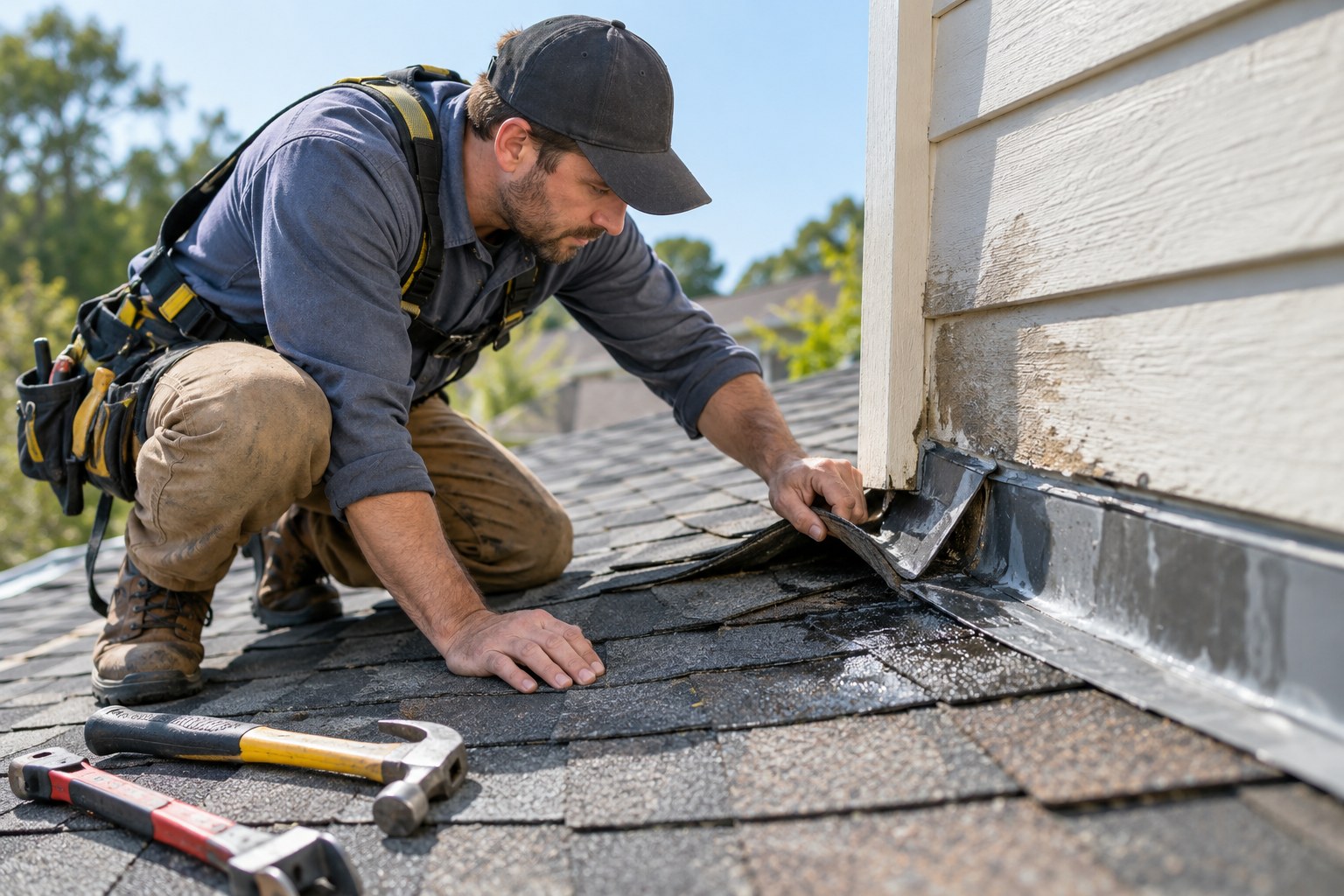
| Town residential | Conventional weathering plus hail and wind events | Pipe boots, valleys, chimney flashing and roof-to-wall transitions |
The most locally relevant service, covering the dairy, livestock and farm buildings across Hopkins County. How metal roof leak repair works.
For establishing the real condition of a panel roof, including the underside that cannot be judged from the yard. How roof leak inspection works.
For the low-slope membrane roofs along the Interstate 30 corridor and around the courthouse square. How commercial leak repair works.
For hail and high-wind events, which reach large agricultural roofs with little to shelter them. How storm damage repair works.
Because the atmosphere inside them is harder on steel than the weather outside. Animal housing generates constant moisture and ammonia, and warm humid air rises and sits against the underside of the roof panel. Over years that attacks the panel coating, the cut edges and above all the fasteners, so the roof corrodes upward from beneath while the weather face still looks sound.
Look at where it is failing. On an agricultural building the corrosion usually starts at the fastener shanks and the underside of the panel, neither of which is visible from above. By the time rust shows on the outer face the fastener has often already lost its grip and its washer, and water is tracking down the shank every time it rains.
The fasteners, and specifically their washers. Count how many have backed out, how many are over-driven so the washer has squeezed out from under the head, and how many show rust streaking below them. That one survey tells you more about the condition of a panel roof than anything else you can do from the ground.
Yes. The distribution, retail and lodging buildings along the interstate are generally low-slope membranes with rooftop mechanical equipment, so the priorities are drainage, seams, curb flashing and parapet terminations rather than fasteners and laps.
It depends on whether the corrosion is localised or general. Isolated fastener failures and a few corroded laps on an otherwise sound roof are a repair. Widespread pitting of the panel underside, corrosion along many cut edges, or purlins showing rust where water has been running down them for years point toward a larger piece of work, and that judgement should come from inspecting the underside, not just the top.
Roof leak service covers Hopkins County and the surrounding northeast Texas region.
Lamar County, about thirty-seven miles north on State Highway 19.
Hunt County, roughly thirty miles west on Interstate 30.
Bowie County, about a hundred miles east on Interstate 30.
Smith County, south of Hopkins County in East Texas.
For an agricultural building, the useful details are what the building houses, roughly how old the roof is, and whether rust is showing on the purlins inside.
Call Now · (844) 625-7943