
The rebuilt downtown
Masonry commercial blocks around the Plaza and the surrounding streets, with low-slope roofs behind parapets. Base flashing, coping, scuppers and party-wall conditions are the priorities.
Paris has an unusual roof inventory for a Texas city its size, and the reason is a single day. Major fires struck in 1877, 1896 and again in 1916, and the 1916 fire forced the entire downtown to be rebuilt, courthouse included.
That produced a commercial district where a very large number of buildings share an age and a construction type — and roofs that start together tend to reach their limits together.
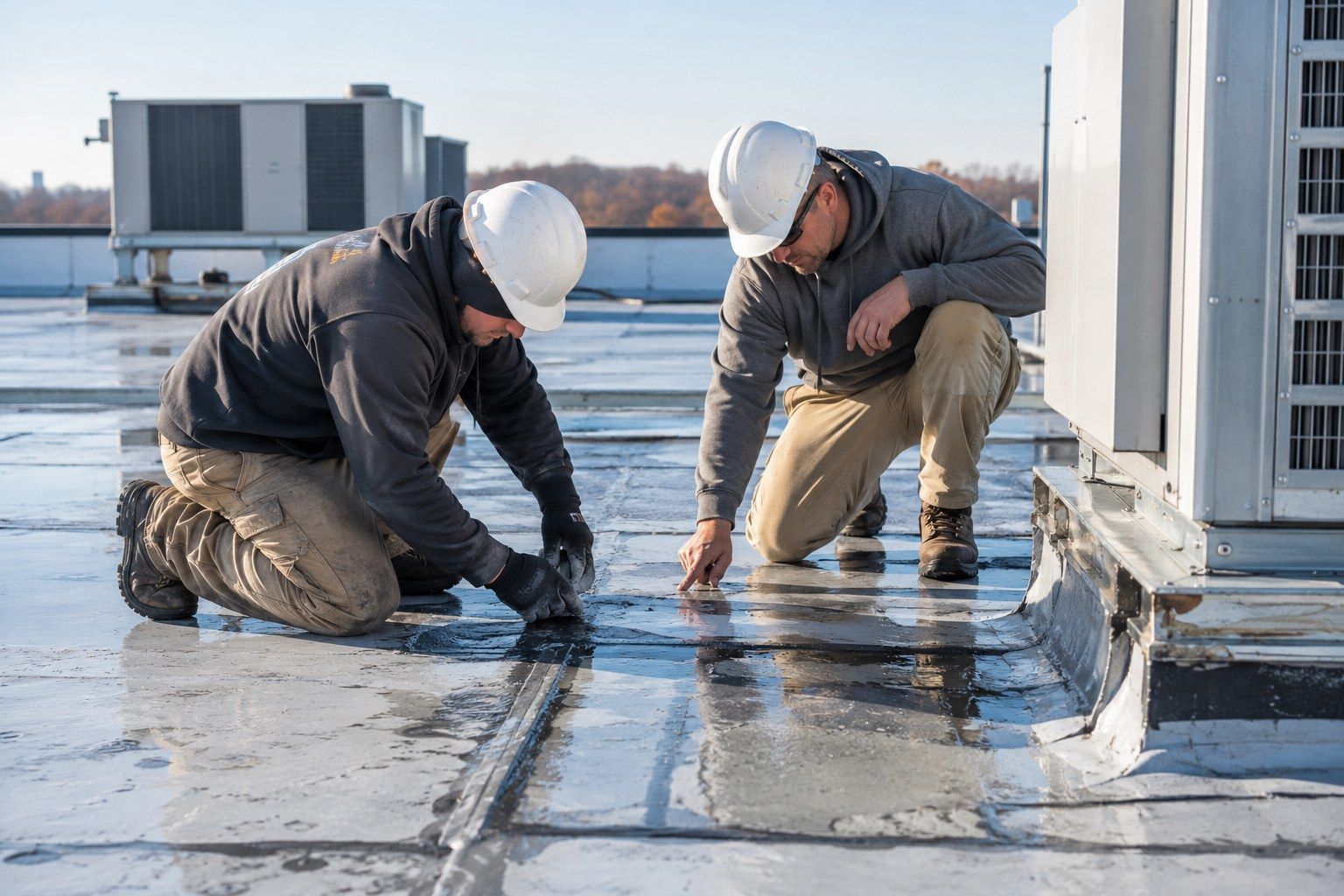
On a Paris downtown building, start at the parapet. The turn-up where the roof meets the wall and the coping on top of it account for a large share of leaks on this kind of construction.
Most towns accumulate their buildings gradually, so roofs come due for attention in a steady trickle. Paris is different. The fire of March 1916 destroyed a large part of the city, and what replaced it went up over a compressed period in a consistent style: masonry commercial blocks, flat or near-flat roofs, and parapet walls fronting the street.
More than a century later, that shared origin still shapes the local roofing picture. Buildings of the same age, built the same way, with the same details, tend to develop the same problems within the same window. When one owner on a block discovers a failed parapet flashing, it is worth the owners either side taking a look as well.
The practical value of knowing this is that it turns a surprise into something predictable. A roof on a 1910s commercial building is not expected to be original — it will have been recovered several times — but the parapet construction, the coping details and the drainage layout underneath are frequently original, and those are the parts that decide where water gets in.
A parapet is the part of the exterior wall that carries on above roof level. It is why so many downtown buildings present a tall flat face to the street with no visible roof behind it. Architecturally it is a facade; practically it is a wall with weather on both sides and a roof terminating against its inner face.
The roof covering has to turn up that inner face and stop somewhere, and that stopping point — the base flashing — is under constant stress as the building moves and the materials expand and contract. If the termination loses adhesion or the counterflashing above it lifts, water runs behind the roofing instead of onto it.
The coping is the cap along the top of the wall. It takes direct rain, direct sun and the full daily temperature swing, and its joints move more than almost anything else on the building. A failed coping joint does not drip onto the roof where someone might see it; it lets water into the top of the wall, where it travels down inside the masonry and emerges somewhere unexpected.
Downtown blocks are built as terraces. Buildings share party walls, and frequently share the parapet that runs along the top of that wall. That makes a leak at or near the shared wall a genuinely awkward problem, because the point where water enters and the building in which it appears are not necessarily the same property.
Water that gets past a shared coping or a failed base flashing on one side can run along the top of the wall, down through the masonry and emerge inside the adjoining building. The owner who sees the stain calls about it, work gets specified on their roof, and the leak continues because the defect was always on the other side of the wall.
The way to avoid that is to establish the water path before committing to a scope, which on a terrace usually means looking at both roofs. It is a conversation nobody enjoys having with a neighbour, but it is considerably cheaper than repairing the wrong roof twice.
The three groups need different first questions, and the downtown group is the one most likely to be misdiagnosed.
Masonry commercial blocks around the Plaza and the surrounding streets, with low-slope roofs behind parapets. Base flashing, coping, scuppers and party-wall conditions are the priorities.
Houses of many periods across the city, predominantly shingle. Penetrations, valleys, chimney flashing and roof-to-wall transitions account for most leaks.
Retail, lodging and light commercial along the loop and the US 82 and US 271 approaches, with conventional low-slope membranes and rooftop mechanical equipment.
Paris is the seat of Lamar County in northeast Texas, served by ZIP codes 75460 and 75462, with area codes 903 and 430. US 82 and US 271 cross here, and Loop 286 rings the city over roughly fourteen miles, carrying US 82 around the north side of downtown and US 271 through the commercialised north-east stretch. The city lies about fifteen miles south of the Red River and roughly 103 miles north-east of Dallas.
Loop 286 is the organising route, with US 82 Business running through as Lamar Avenue and US 271 Business as Clarksville Street. US 271 continues north toward Hugo, Oklahoma, around twenty-three miles away.
East of the loop, US 82 runs on through the Lamar County communities of Reno, Sun Valley and Blossom.
Paris sits on the vegetation boundary where the Piney Woods of northeast Texas give way to the Blackland Prairie extending to the south-west, so soil and tree cover differ noticeably across the area.
Pat Mayse Lake and Lake Crook lie within the wider ZIP 75462 area, along with the Lamar County airport.
The Plaza is the centre of the rebuilt downtown, with the Culbertson Fountain commemorating the city’s recovery after the 1916 fire and the restored 1917 Lamar County Courthouse nearby.
The Grand Theatre and the Plaza Theatre are among the recognisable downtown buildings, and the Sam Bell Maxey House State Historic Site and Paris Junior College on Clarksville Street add to the local building mix.
Building age and location on the block are strong predictors here, but the specific condition of the parapet, coping, drainage and previous repairs on the roof in question still determines where water is actually entering.
Paris holds a century of construction in a small area, and the assembly decides which details can realistically be passing water.
Over downtown commercial and corridor retail. Seams, base flashing, coping and internal drainage carry the risk rather than the open field.
Found on buildings recovered during earlier decades. Blistering, ridging and the condition at every wall and penetration matter most.
The standard residential covering. Valleys, pipe boots, chimney flashing and wall transitions are the usual sources.
Any point where roofing meets brick or stone. Counterflashing should be let into a joint rather than sealed onto the face of the masonry.
The core local service for the downtown commercial district and the corridor retail around Loop 286. How commercial leak repair works.
For parapet base flashing, coping terminations and roof-to-wall junctions on masonry buildings. How flashing repair works.
Where drainage, ponding or seam failure on a low-slope roof is the suspected cause. How flat roof leak repair works.
Appropriate on an older building where layered previous repairs have obscured the original water path. How roof leak inspection works.
Because a large part of downtown Paris was rebuilt in one go after the 1916 fire, so a great many buildings share an age and a construction type. Roof components have service lives, and when the starting date is the same the end dates cluster. It is the same reason a street of houses built in one subdivision phase tends to need roofs in the same few years.
Usually the junction between the roof and the parapet wall, and the coping that caps that wall. The roof membrane has to turn up the inside face of the parapet and terminate there, and the coping on top is the most weather-exposed horizontal surface on the building. Neither is visible from the street, which is why both get neglected.
That has to be established before anyone starts work, and it is not always the obvious answer. Water entering at or near a shared parapet can run along the wall and appear inside the neighbouring building. Tracing it properly, rather than assuming the leak is above the stain, is what avoids paying for a repair on the wrong roof.
Paris sits on the boundary where the Piney Woods of northeast Texas meet the Blackland Prairie extending to the south-west, so ground conditions are not uniform across the area. Where a building sits on more reactive clay soil, seasonal movement can work at roof-to-wall junctions and parapet terminations over time.
Generally yes, because the consequences compound faster. Water reaching soft historic mortar, original timber framing or lath-and-plaster finishes causes damage that is slower to show and more involved to put right than the same leak above a modern ceiling. The ceiling stain is usually the cheapest part of the problem.
Roof leak service covers Lamar County and the wider northeast Texas region.
Hopkins County, about thirty-seven miles south on State Highway 19.
Grayson County, west of Paris near the Red River.
Bowie County, east along the US 82 corridor.
Hunt County, south-west of Paris toward the metroplex.
For a downtown building the useful details are whether the stain is near an exterior or shared wall, and whether the water follows heavy rain or every rainfall.
Call Now · (844) 625-7943