
Standing-seam metal
Leaks concentrate at terminations and anything cut into the panel rather than along the seam. Pipe curbs, kerbs, closures and wall transitions are the priorities.
Kerrville was settled around a shingle-making camp, and roofing has been part of the local story since. Today the Hill Country combination that matters most is metal roofing and hail, and the two interact in ways that are easy to misdiagnose.
Hail that does not puncture a panel can still deform a seam, split a sealant bead or unseat a fastener washer. Dents and leaks are not the same finding, and separating them is the first job here.
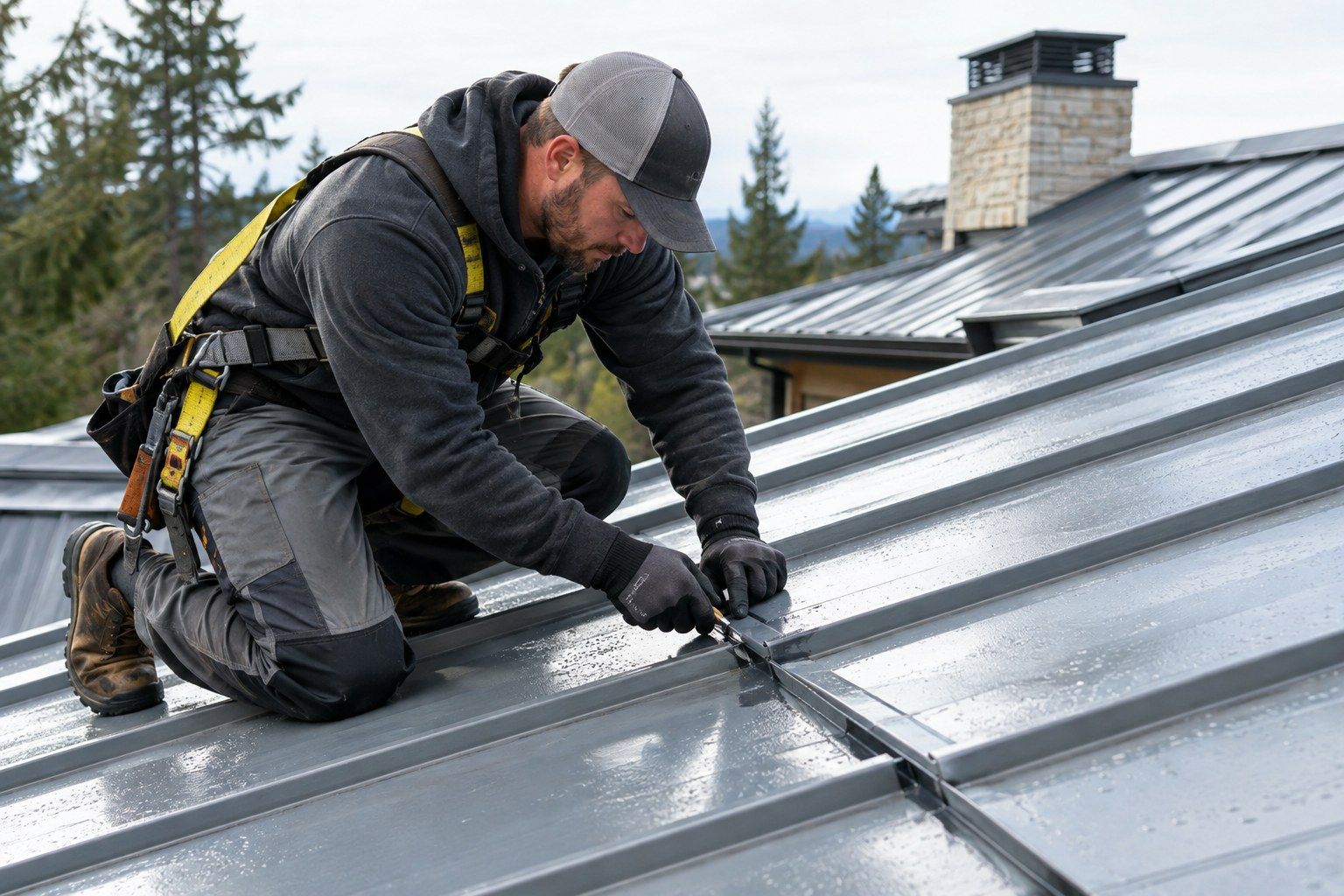
On a metal roof, cosmetic denting and functional damage are separate findings. Assess the seams, closures, fasteners and penetrations, not the appearance of the panel field.
Metal roofing is widespread across the Hill Country for good reasons: it handles heat well, sheds water fast and lasts a long time. It also responds to hail very differently from asphalt shingle, and that difference is the source of most confusion about whether a roof is damaged.
A hailstone that strikes a metal panel in the field usually leaves a dent. A dent in the flat of a panel is a cosmetic matter; the panel still sheds water. The problems arise where the hail strikes something that has a sealing function: the upstand of a standing seam, the closure strip at a ridge or eave, the sealant at a pipe penetration, or the head of an exposed fastener and the washer beneath it.
So the roof can be visibly covered in dents and watertight, or barely marked and leaking. Judging a metal roof by how dented it looks is the single most common error after a Hill Country hailstorm, in both directions.
The other thing that distinguishes a metal roof is that it moves. A long panel in the Texas sun expands measurably through the day and contracts again overnight, and it does that every day for decades. Everything attached to it has to accommodate that movement or eventually give way.
On a standing-seam system the panels are designed to float on concealed clips, so the field accommodates movement by design. The weak points are the places where that freedom is interrupted: a pipe curb, a skylight kerb, a solar mount, an eave or ridge closure, or a transition into a valley or a wall. Those are fixed points on a moving roof.
On an exposed-fastener system every screw is a fixed point, and the whole panel works against each of them. Over time the holes elongate, screws back out or over-tighten, and the sealing washers compress, harden and split. This is why an older exposed-fastener roof tends to develop many small leaks rather than one large one.
The assembly determines the inspection. A standing-seam roof and an exposed-fastener roof look similar from the ground and fail in almost opposite ways.
Leaks concentrate at terminations and anything cut into the panel rather than along the seam. Pipe curbs, kerbs, closures and wall transitions are the priorities.
Fasteners and their washers, panel end laps, and ridge and eave closures. Common on outbuildings, barns and shops as well as houses.
Still widespread. Hail bruising can break the mat without removing granules visibly, and the resulting leak may appear well after the storm.
Where a roof meets a stone or stucco wall, counterflashing needs to be let into the wall rather than sealed onto its face. A frequent source of persistent leaks.
A practical orientation to what matters on each roof type after a Hill Country hailstorm. Findings still have to be confirmed on the roof.
| Roof type | Generally cosmetic | Potentially functional |
|---|---|---|
| Standing-seam metal | Dents in the flat of the panel; minor surface marking | Deformed seam upstands, damaged ridge or eave closures, split sealant at penetrations |
| Exposed-fastener metal | Dents between fastener lines | Struck fastener heads, displaced or cracked washers, damaged closure strips and laps |
| Asphalt shingle | Light surface scuffing, isolated granule displacement | Bruised or fractured mat, broken seal bonds, cracked or split pipe boots |
| Flashing and accessories | Minor denting on visible metal faces | Deformed or lifted counterflashing, damaged vent and skylight flashing, split sealant joints |
Kerrville is the seat of Kerr County in the Texas Hill Country, served by ZIP codes 78028 and 78029, with area code 830. The city sits on Interstate 10 about sixty-five miles north-west of San Antonio, at an elevation of roughly 1,600 feet. State Highway 16, locally Sidney Baker Street, is the main road through the centre of the city.
State Highway 16 leads north-east twenty-four miles to Fredericksburg and south-west the same distance to Medina. State Highway 27 runs west six miles to Ingram and east eighteen miles to Comfort, and State Highway 173 leads south twenty-five miles to Bandera.
Boerne lies about thirty-eight miles south-east and Harper roughly thirty-one miles north.
The Guadalupe River runs through the city with the downtown area on its north-eastern side, and Town Creek, Turtle Creek, Johnson Creek and Verde Creek feed the system locally. Nimitz Lake and Kerrville-Schreiner Park sit on the river.
Hills on either side of the valley mean meaningful differences in wind exposure between ridgeline and valley-floor properties.
Schreiner University and the James Avery Craftsman headquarters off Interstate 10 are among the larger local institutional and commercial sites, and the Kerr County Ag Complex sits on State Highway 27 east of town.
The mix includes stone and masonry homes with large porches and overhangs, which add roof planes and wall transitions to the inspection.
Exposure and roof type narrow the likely causes, but the condition of the seams, fasteners, closures and wall terminations on the specific roof still determines where the water is entering.
The most locally relevant service given how much Hill Country roofing is standing-seam or exposed-fastener metal. How metal roof leak repair works.
For hail and high-wind events, where the functional damage is frequently not the damage that is visible. How storm damage repair works.
For roof-to-wall transitions on stone, stucco and masonry walls, where let-in counterflashing matters. How flashing repair works.
Appropriate after a hailstorm when nothing is obviously wrong but condition needs establishing before a leak develops. How roof leak inspection works.
Yes, and this is the most commonly misread situation on a Hill Country metal roof. Hail large enough to dent a panel is also large enough to deform the raised seam, split a sealant bead at a penetration, or drive the washer on an exposed fastener below the plane of the panel. None of those is a hole, and all of them can leak. Cosmetic denting and functional damage are separate findings and need assessing separately.
Because the screws are the only thing resisting a roof that moves every day. Metal panels expand and contract measurably with temperature, and over years that movement enlarges the hole, works the screw loose or compresses and cracks the neoprene washer under its head. A roof with a few thousand fasteners has a few thousand potential leak points, and on an older panel roof a proportion of them will have failed.
It affects the transition between them. Where a roof meets a masonry or stone wall, the counterflashing should be let into a mortar joint or a cut reglet so that water running down the wall is directed out onto the roof surface. On rough or irregular stonework that detail is harder to execute, and surface-applied sealant instead of a proper let-in termination is a common shortcut that fails within a few years.
Reasonably soon. Hail damage frequently does not leak immediately; a bruised shingle or a compromised seam can take weeks or months to fail, by which time connecting it to the storm is harder. Roof condition is also much easier to assess while the evidence is recent.
Indirectly. Kerrville sits at around 1,600 feet with the Guadalupe River through the middle of the city and hills on either side, and roofs on exposed ridgelines take more wind than those in sheltered river valleys. Large overhangs and porches, common on houses here, also add roof planes and junctions.
Repair is usually possible, because the problem is rarely the seam run itself. On standing-seam systems leaks concentrate at terminations and anything cut into the panel: pipe curbs, skylight kerbs, eave and ridge closures, and valley or wall transitions. Those are discrete details and can be addressed individually.
Dents in the field of a metal panel do not by themselves let water in. If the seams, closures, fasteners and penetration flashing are intact and performing, a dented roof can remain serviceable for years. Conversely, a roof with very little visible marking can be leaking at a single struck fastener or a split sealant joint.
The defensible approach is to assess each category of detail on its own terms and report what is actually found: which details are performing, which are not, and whether the ones that are not can be addressed individually on an otherwise sound roof.
Roof leak service covers the Hill Country and the wider South Central Texas region.
Gillespie County, twenty-four miles north-east on State Highway 16.
Kendall County, about thirty-eight miles south-east toward San Antonio.
Comal County, east of Kerrville on the Guadalupe.
Bexar County, sixty-five miles south-east on Interstate 10.
For a metal roof the useful details are the panel type, the approximate age, whether hail was involved and where the water is appearing inside.
Call Now · (844) 625-7943