
Historic masonry buildings
Limestone and stucco walls with metal or shingle roofs, in town and on surrounding properties. The roof-to-wall termination is the dominant risk, followed by chimney flashing.
Fredericksburg was established in 1846 by German immigrants, and the limestone buildings along and around Main Street are still a defining part of the town. Roofing a building like that is mostly a question of how the roof meets the stone.
Combine historic masonry with the traditional metal roofing common across Gillespie County and the hail this part of the Hill Country receives, and the local leak pattern becomes quite specific.
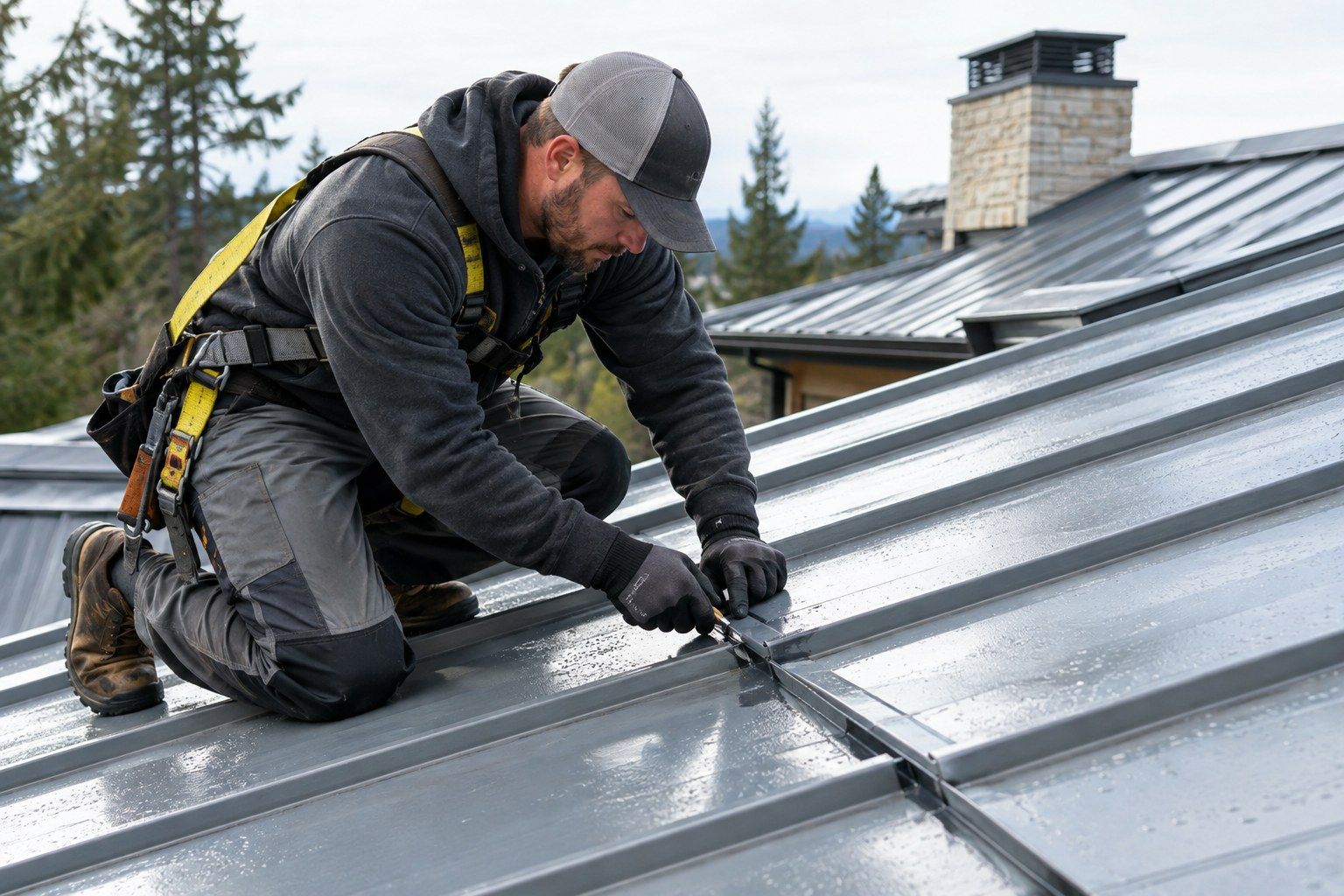
On a conventional house, a roof-to-wall junction is a matter of weaving step flashing into the roofing courses and covering it with counterflashing tucked behind the siding. On a limestone building there is nothing to tuck behind. The counterflashing has to be let into a mortar joint or into a reglet cut in the stone, and then sealed.
That is a more demanding detail, and the consequences of getting it wrong are worse. Historic lime mortar is soft, joints are irregular, and cutting into original stonework is something to avoid where possible. The common shortcut is to run sealant along the face of the stone instead of forming a proper let-in termination.
Surface sealant on masonry has a short service life. It loses adhesion as the stone and the metal expand and contract at different rates, and once it has, water running down the wall goes behind the flashing instead of out onto the roof. From inside, that presents as a persistent leak near an exterior wall that no amount of work on the roof field will fix.
Metal roofing has a long history in the German Hill Country settlements, and standing-seam and corrugated panels remain common across Fredericksburg and the surrounding county on houses, outbuildings, barns, guest properties and commercial buildings alike.
The panels are the durable part. What has a shorter service life is everything that interrupts them: the sealant at a pipe penetration, the closure strips at the ridge and the eave, the fasteners on an exposed-fastener system and the washers under their heads, and the flashing where the roof runs into a wall or a valley.
This is why most metal roof leaks here are maintenance findings at specific points rather than failures of the roof as a whole, and why a forty-year-old panel roof can be entirely serviceable while leaking at three penetrations. Thermal movement is the driver: panels expand and contract daily, and every fixed point on a moving roof is worked by that cycle.
The county’s roof stock ranges from pre-Civil War masonry to current construction, and the method changes with it.
Limestone and stucco walls with metal or shingle roofs, in town and on surrounding properties. The roof-to-wall termination is the dominant risk, followed by chimney flashing.
Mixed historic and later commercial frontage in the Main Street Historic District, including low-slope roofs behind parapets where coping and base flashing carry the risk.
Newer homes and guest properties with large porches, deep overhangs, complex rooflines and standing-seam metal. Terminations and anything cut into a panel are the priorities.
Hail is a recurring fact of Hill Country weather, and it affects the two dominant local roof types quite differently. On an asphalt shingle roof, hail can bruise or fracture the mat without obviously removing granules, and a bruised shingle may not leak for months. On a metal roof, hail dents panels, and dents in the flat of a panel are a cosmetic matter rather than a leak.
What matters on metal is whether hail struck something with a sealing function. A deformed seam upstand, a damaged ridge or eave closure, split sealant at a penetration, or a struck fastener head with a displaced washer: these are functional findings, and none of them is conspicuous from the ground.
The practical consequence is that a heavily dented metal roof may be watertight and a barely marked one may be leaking. Appearance is a poor guide in both directions, which is why the details get assessed rather than the panel field.
Fredericksburg is the seat of Gillespie County, served by ZIP code 78624, with area code 830. US 290 and US 87 combine along Main Street through the centre of town, and State Highway 16 arrives from the south-west, running roughly twenty-two miles north-east from Interstate 10 at Kerrville before joining US 87 and US 290. Ranch Road 965 leads north toward Enchanted Rock.
US 87 runs north–south, linking the town toward Kerrville and San Antonio in one direction and Brady in the other. US 290 is the main east–west route, carrying traffic toward Austin and Johnson City eastward.
Ranch Road 965 runs about seventeen miles north to State Highway 16 in southern Llano County, providing access to Enchanted Rock State Natural Area.
The Main Street Historic District, the Vereins Kirche Museum, the Pioneer Museum, Fort Martin Scott and the National Museum of the Pacific War are among the town’s recognisable places. Barons Creek runs through the town.
Enchanted Rock, a pink granite dome, lies around seventeen to eighteen miles north in Gillespie and Llano counties, and Bear Mountain roughly ten miles north.
The US 290 corridor east of town toward Stonewall is the centre of the local wine industry, with the LBJ Ranch about fifteen miles east. Old Tunnel State Park sits south of the town on Old San Antonio Road.
Gillespie County Airport serves the area, and Harper lies west along US 290.
Building type and roof material narrow the likely cause considerably here, but the condition of the specific terminations, sealants, closures and fasteners on the roof in question still determines where water is entering.
For the standing-seam and corrugated panel roofs common across the town and the surrounding county. How metal roof leak repair works.
The most locally relevant service for historic limestone buildings, where the roof-to-wall termination is the usual point of failure. How flashing repair works.
For hail and high-wind events, where the functional damage on a metal roof is rarely the damage that shows. How storm damage repair works.
Appropriate on a historic building where the water path through the wall and roof assembly needs establishing before work begins. How roof leak inspection works.
It is partly tradition and partly performance. Standing-seam and corrugated metal has been used on buildings in the German Hill Country settlements for well over a century, and it suits the climate: it sheds water fast, handles heat and resists hail better than many alternatives. On historic properties it is also often what the building had originally, which matters where appearance is being preserved.
The wall. Where the roof meets limestone, counterflashing needs to be let into a mortar joint or a cut reglet so water running down the wall is thrown clear onto the roof. Historic lime mortar is soft and irregular, cutting into original stonework is undesirable, and the result is that these terminations are often surface-sealed instead. Surface sealant on stone has a short life, and when it fails the water goes into the wall.
Often more. Small ancillary buildings tend to have simple roofs but a high ratio of edge and junction to field area, and they are usually inspected and maintained less often than the main house. A failed detail on a small roof puts water into a small structure quickly.
At the junctions on the windward elevation rather than at the roof field. Wind-driven rain can be pushed up a slope, under laps and behind flashing that performs perfectly in vertical rain. Roof-to-wall terminations, dormer cheeks, ridge and eave closures and the area behind the drip edge are the usual culprits.
They need periodic attention at their details. The panels themselves are durable, but the sealant at penetrations, the fasteners on exposed-fastener systems and the closures at ridge and eave all have service lives considerably shorter than the metal. Most metal roof leaks are maintenance items at those points rather than failures of the roof.
Roof leak service covers the Hill Country and the surrounding Central Texas region.
Kerr County, twenty-four miles south-west on State Highway 16.
Kendall County, south of Fredericksburg toward San Antonio.
Hays County, east along the US 290 corridor.
Travis County, east of Fredericksburg on US 290.
The useful details are the roof material, whether the building has stone or stucco walls near the stain, and whether hail or high wind preceded the leak.
Call Now · (844) 625-7943