
Town residential
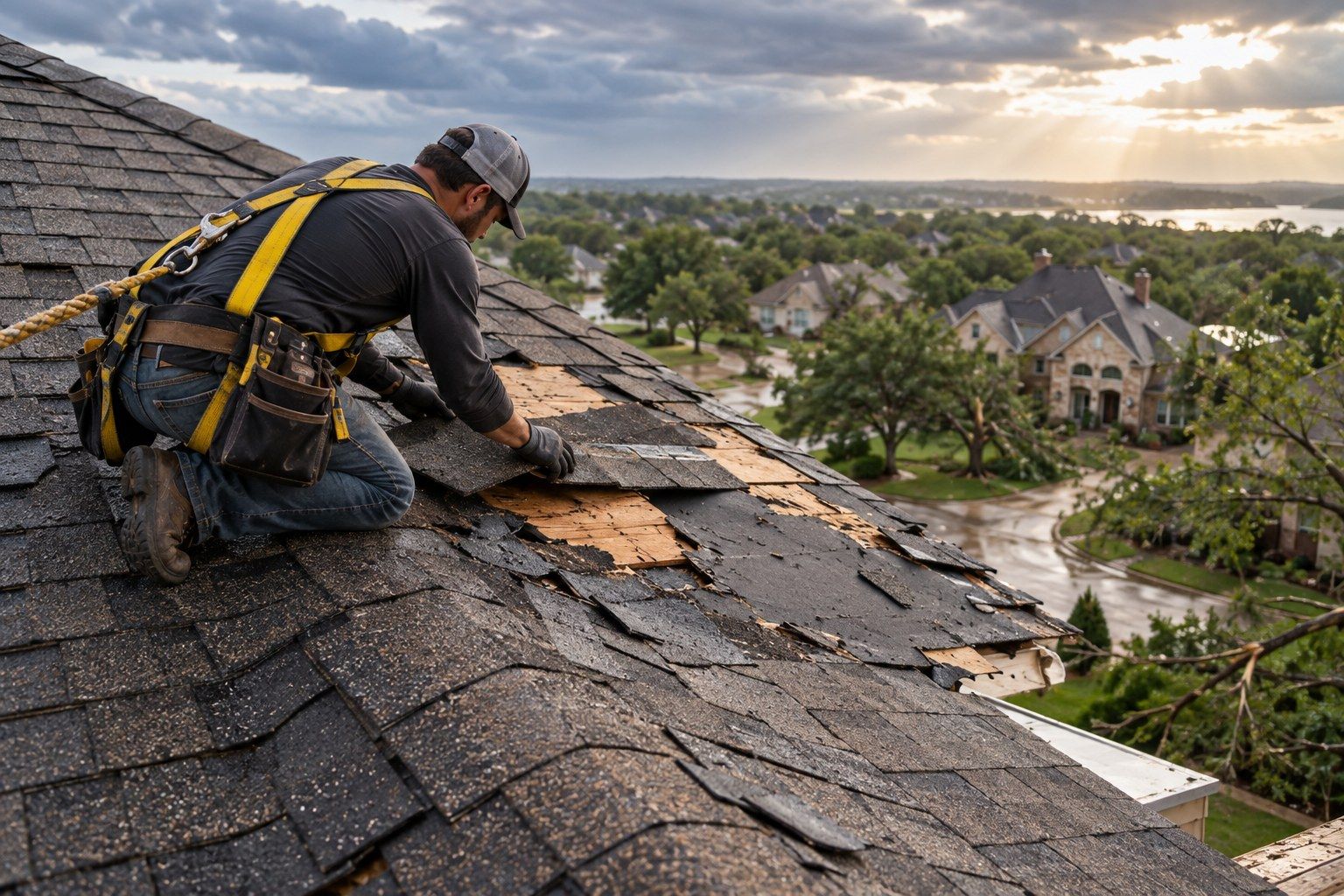
Houses across Bay City, predominantly shingle. Seal bonds, edge metal, pipe boots and flashing are what the wind reaches first.
Bay City sits on flat coastal prairie along the Colorado River, around twenty-five miles north of Matagorda Bay. That is inland enough that people often assume the coast is somebody else’s problem, and close enough that it is not.
Matagorda County is one of the fourteen first-tier coastal counties designated by the Texas Department of Insurance, which changes what is expected of roofing work here.
Being twenty-five miles from the bay does not put a property outside the designated coastal requirements. Matagorda County is a first-tier county in its entirety.
Distance from the water is a weaker protection than it sounds, and the reason is terrain. A tropical system loses energy over land largely through friction with what it passes over — hills, forest, dense built-up areas. The Texas coastal prairie between Matagorda Bay and Bay City offers almost none of that. It is flat, open and agricultural.
The practical effect is that wind speeds this far inland remain high enough to matter for roofs. It is why Matagorda County is included among the fourteen counties bordering the Gulf that the Texas Department of Insurance designates as catastrophe areas, rather than only the communities directly on the bay.
The second effect is rainfall. A slow-moving tropical system over flat ground with limited drainage delivers very large volumes over a long period, and that tests the roof’s drainage capacity rather than just its covering. Roofs that shed an ordinary Gulf Coast shower without difficulty can be overwhelmed when rain continues at high intensity for many hours.
Inside the designated catastrophe areas, the Texas Department of Insurance divides the coast into three wind zones: Seaward, Inland I and Inland II. Each carries its own basic wind speed requirement, derived from the recognised national wind speed mapping, that structures in that zone are expected to be designed and constructed to resist.
This is the part that surprises people. It is not simply a question of which county you are in; it is where within the coastal band a particular property sits. Two buildings in the same county can sit in different zones and have different requirements applied to them, which means the answer for a property near the bay is not automatically the answer for one on the northern side of the county.
For roofing, that matters before the work rather than after it. The requirement affects how a roof covering is expected to be fastened and detailed, and it is cheaper to establish what applies at the point of specifying a repair than to discover it when a certificate is needed. The Texas Department of Insurance is the authority on which zone applies to a given address.
The roof damage that causes the most trouble after a tropical system is rarely the damage that makes the news. Missing sections and obvious holes get dealt with immediately. What gets missed is everything that still looks intact.
Wind uplift routinely breaks the adhesive bond between shingle courses without moving the shingles at all. The roof looks correct, but the courses no longer resist water being driven underneath them, so it leaks in the next storm that arrives with wind from a similar direction. Edge metal, drip edge and ridge caps get lifted and settle back approximately where they were, with the termination compromised.
Flashing is the third category. Step flashing, counterflashing and the details around penetrations depend on position and overlap, and a small shift is enough to let driven rain in behind the metal instead of onto the roof surface. None of it shows from the ground, and all of it is far easier to identify while the evidence is recent.
All three sit inside the same designated coastal county, and all three are exposed by the same flat terrain.
Houses across Bay City, predominantly shingle. Seal bonds, edge metal, pipe boots and flashing are what the wind reaches first.
Downtown buildings around the courthouse square and commercial frontage along State Highways 35 and 60, with low-slope membranes and rooftop equipment.
Agricultural and industrial buildings spread across the county on open ground, predominantly long-span metal, where fasteners, laps and closures take the load.
Bay City is the seat of Matagorda County on the Texas Gulf Coast, served by ZIP code 77414, with area code 979. State Highways 35 and 60 meet here, with State Highway 71 also serving the area. The city lies along the Colorado River roughly twenty-five miles north of Matagorda Bay, about seventy-five to eighty-five miles south-west of Houston.
State Highway 35 runs along the coast, with Palacios about half an hour south-west. State Highway 60 crosses it, and State Highways 457 and 521 serve other parts of the county.
Wharton lies around twenty-five miles north and Victoria roughly eighty-five miles to the south-west.
The Colorado River runs through the city and reaches the Gulf at the LCRA Matagorda Bay Nature Park on FM 2031. Matagorda Bay, East Matagorda Bay and Tres Palacios Bay lie across the county.
The surrounding land is flat coastal prairie, which is why wind arriving from the Gulf retains so much of its strength this far inland.
The Matagorda County Courthouse anchors the downtown square, and the Matagorda County Museum, Le Tulle Park and the Matagorda County Birding Nature Center on State Highway 35 are among the recognisable local sites.
ZIP 77414 also covers parts of Sargent, Wadsworth, Markham, Midfield and Cedar Lane, and there is significant industrial activity in the wider county.
Whether a property falls in the Seaward, Inland I or Inland II wind zone is worth establishing with the Texas Department of Insurance before significant roof work, because it affects what is required of that work.
The most locally relevant service, given the county’s exposure to tropical weather and the kind of damage wind leaves behind. How storm damage repair works.
Appropriate after a storm when nothing obvious shows but condition needs establishing while the evidence is recent. How roof leak inspection works.
For driven rain entering behind flashing that was shifted rather than removed by wind. How flashing repair works.
When water is actively entering and stopping ingress comes before diagnosis. How emergency leak repair works.
No, and the distance is smaller than people assume. The city lies roughly twenty-five miles north of Matagorda Bay on flat coastal prairie, and Matagorda County is one of the fourteen first-tier coastal counties designated by the Texas Department of Insurance. Flat terrain offers very little to slow a storm, so wind reaching this far inland is still capable of damaging roofs.
Within the designated catastrophe areas, the Texas Department of Insurance divides the coast into three wind zones — Seaward, Inland I and Inland II — each with its own basic wind speed requirement that structures are expected to be designed and built to resist. Which zone a property falls in affects what is required of roofing work there, so it is worth establishing before any significant repair is specified.
It may. In the designated coastal counties, a certificate of compliance from the Texas Department of Insurance, the WPI-8, is used as proof of eligibility for windstorm and hail coverage through the Texas Windstorm Insurance Association. An application for inspection generally has to be submitted before work begins, so the time to check is before a repair starts rather than afterwards. TDI is the authority on what applies to a given property.
The damage that is not obvious. Wind commonly breaks the adhesive seal between shingle courses without displacing them, lifts and resettles edge metal and ridge caps, and disturbs flashing enough to let driven rain behind it. All of that looks normal from the ground and leaks at the next storm.
The exposure is the same but the buildings differ. Matagorda County has a great deal of agricultural and industrial roof area, much of it long-span metal on open ground, where fasteners, panel laps and closures take the wind load rather than shingle seal bonds.
Roof leak service covers Matagorda County and the wider Texas Gulf Coast.
Brazoria County, north-east along the coast.
Brazoria County, north-east of Bay City.
Galveston County, further north-east on the coastal plain.
Victoria County, south-west of Matagorda County.
If a storm was involved, the wind direction and whether hail came with it are the most useful details. For planned work, check the wind zone first.
Call Now · (844) 625-7943