
Wind-driven rain
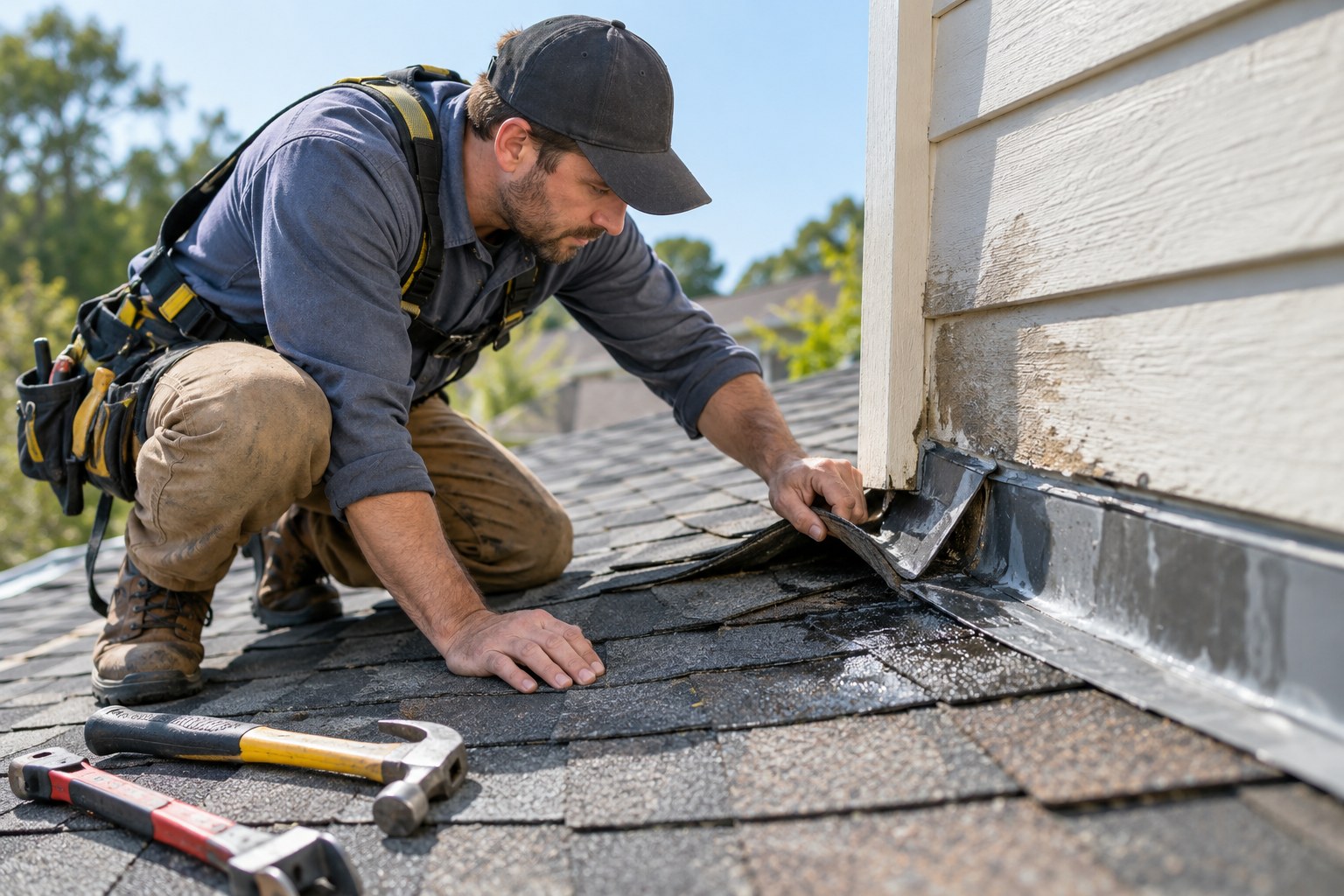
Rain arriving under pressure travels up the slope, under courses and behind flashing that handle vertical rain without difficulty. The slopes and details facing the prevailing storm direction come first.
Santa Fe sits on the coastal plain of Galveston County, about sixteen miles north-west of Galveston along Highway 6. The city was formed in 1978 from the older railway communities of Alta Loma and Arcadia.
Because it is in a first-tier coastal county, roof work here sits inside the state windstorm framework — which is something worth understanding before a repair, not after it.
On the coast, establish what certification applies before the repair is specified. The Texas Department of Insurance is the authority on what a particular property and a particular piece of work require.
Most roof repairs in Texas involve the property owner and whoever does the work. On the coast there is a third party, and leaving it out causes problems that surface years later.
Galveston County is one of the fourteen first-tier counties bordering the Gulf that the Texas Department of Insurance designates as catastrophe areas. Within those counties, the WPI-8 certificate of compliance is used as proof that a property, or work done to it, meets the applicable building code requirements, and it functions as proof of eligibility for windstorm and hail coverage through the Texas Windstorm Insurance Association.
The practical consequence is that a technically excellent roof can still create a problem if the certification step was skipped. The roof keeps the rain out perfectly well; the difficulty arrives when the property is sold or an insurance question comes up and the certificate is not on file. That is an awkward discovery to make years after the work was finished.
None of this changes how a leak is diagnosed or repaired. It changes when certain questions get asked, and the answer is before the work rather than after.
The windstorm inspection process has its own vocabulary, and the forms are easier to follow once the sequence is clear.
It starts with an application for inspection, submitted to the TDI Inspections Division before work begins. TDI has been explicit that an application which is not submitted in time may result in the certificate not being issued, which is the single most important thing to know about the whole process. From there, inspection takes place in connection with the work, and on satisfactory completion the WPI-8 certificate of compliance is issued. Related forms, the WPI-8E and WPI-8C, cover other routes to the same outcome.
Two points are worth emphasising for roofing specifically. First, the inspection concerns how the work was actually done — fastening and detailing included — which can only be seen while it is open. Second, this is a regulatory and insurance matter rather than a roofing opinion: what applies to a given address, and who may carry out the inspection, are questions for the Texas Department of Insurance and your insurer.
These three account for most wind-related leaks on the Galveston County coastal plain, and none of them is visible from the ground.
Rain arriving under pressure travels up the slope, under courses and behind flashing that handle vertical rain without difficulty. The slopes and details facing the prevailing storm direction come first.
Uplift separates shingle courses from the adhesive strip below without displacing them. Nothing looks wrong, and the roof leaks at the next storm from a similar direction.
Drip edge, rake metal and ridge caps take the highest uplift pressure on any roof and are routinely lifted and resettled, leaving the termination compromised but continuous-looking.
Whatever the covering, wind reaches the perimeter and the penetrations before it reaches anything in the middle of the roof.
The dominant residential covering. Seal-bond integrity after a wind event matters far more here than the appearance of the shingle surface.
On outbuildings, workshops and some homes across the area. Fasteners, panel laps and ridge and eave closures carry the uplift load.
On commercial buildings along Highway 6 and FM 1764, where perimeter terminations and edge metal take the highest wind pressure.
Pipe boots, vents and skylights, which combine a coastal humidity and heat load with direct exposure to driven rain.
Santa Fe is in Galveston County, served by ZIP codes 77510 and 77517, with area code 409. State Highway 6 runs through the city and, with FM 1764, forms the main commercial route; FM 646 and FM 2004 serve other parts of the area. The city lies about sixteen miles north-west of Galveston, eight miles east of Texas City and roughly thirty-five miles south of downtown Houston.
Unincorporated communities formed along the railway at Alta Loma, Arcadia and Algoa. In January 1978 a ballot proposal to incorporate Alta Loma and parts of Arcadia passed, and the city of Santa Fe was established.
Arcadia and Alta Loma are now counted within Santa Fe, and both names remain in local use.
The land is flat coastal plain inland of Galveston Bay and the Gulf. Hitchcock lies to the south-east, Alvin about ten miles north-west, and Texas City to the east.
Santa Fe Independent School District serves the city along with parts of League City, Dickinson, La Marque and Hitchcock.
The Old High School is listed on the National Register of Historic Places, and the Hitchcock Depot at Alta Loma is a recorded Texas landmark.
Highway 6 carries most of the local commercial frontage, with residential streets spreading either side of it.
Being inland of the bay does not place a property outside the coastal framework. Galveston County is a first-tier county throughout, with wind zones varying by location within it.
Appropriate after a wind event, and before any significant work where coastal requirements may apply. How roof leak inspection works.
For wind and tropical weather damage, which here is usually invisible from the ground. How storm damage repair works.
For broken seal bonds, lifted courses and exposed fasteners on the city’s predominantly shingle roof stock. How shingle leak repair works.
For driven rain entering behind flashing, drip edge or a roof-to-wall transition. How flashing repair works.
A WPI-8 is a certificate of compliance issued by the Texas Department of Insurance showing that a property, repair or addition on the Texas coast meets the applicable building code requirements. It applies in the fourteen first-tier coastal counties, and Galveston County is one of them. It functions as proof of eligibility for windstorm and hail coverage through the Texas Windstorm Insurance Association. Whether a particular piece of work needs one should be confirmed with TDI before the work starts.
Because the process is built around inspection during the work rather than afterwards. An application for inspection is generally submitted to the TDI Inspections Division before construction, alteration or repair begins, and TDI has stated that failing to apply in time may result in the certificate not being issued. Once a roof is closed up, the opportunity to inspect what is underneath has gone.
The roof itself may be perfectly sound, but the paperwork gap tends to surface at an awkward moment — typically when a property is being sold or an insurance question arises. Because the certificate is tied to eligibility for windstorm coverage through TWIA, its absence can become a problem long after the work was finished and paid for.
For these purposes, yes. The designation applies to the whole of each first-tier county rather than only the shoreline, and Santa Fe is in Galveston County, roughly sixteen miles north-west of Galveston itself. The coastal band is further divided into wind zones, so the specific requirement varies by location within the county.
Seal bonds between shingle courses, ridge caps, and the drip edge and rake metal around the whole perimeter. Wind damage here usually leaves everything looking approximately where it should be while no longer resisting water driven underneath it.
Roof leak service covers Galveston County and the surrounding coastal region.
Galveston County, about eight miles east of Santa Fe.
Galveston County, east of Santa Fe.
Brazoria County, roughly ten miles north-west.
Galveston County, sixteen miles south-east.
If work is planned rather than urgent, check the certification position before anything starts. If it is urgent, describe where the water is showing and what the weather was doing.
Call Now · (844) 625-7943