
Historic downtown
The Brenham Downtown Historic District holds masonry commercial buildings with low-slope roofs behind parapets. Base flashing, coping, internal drainage and party-wall conditions are the priorities.
Brenham sits roughly halfway between Houston and Austin on US 290, with a historic downtown district at its centre and a county of farms, ranches and rural properties around it. Those two settings produce quite different roofing problems.
The one thing they share is that a leak here is often found late. On a rural or intermittently used building, the cost of a leak has far more to do with how long it ran than with what originally failed.
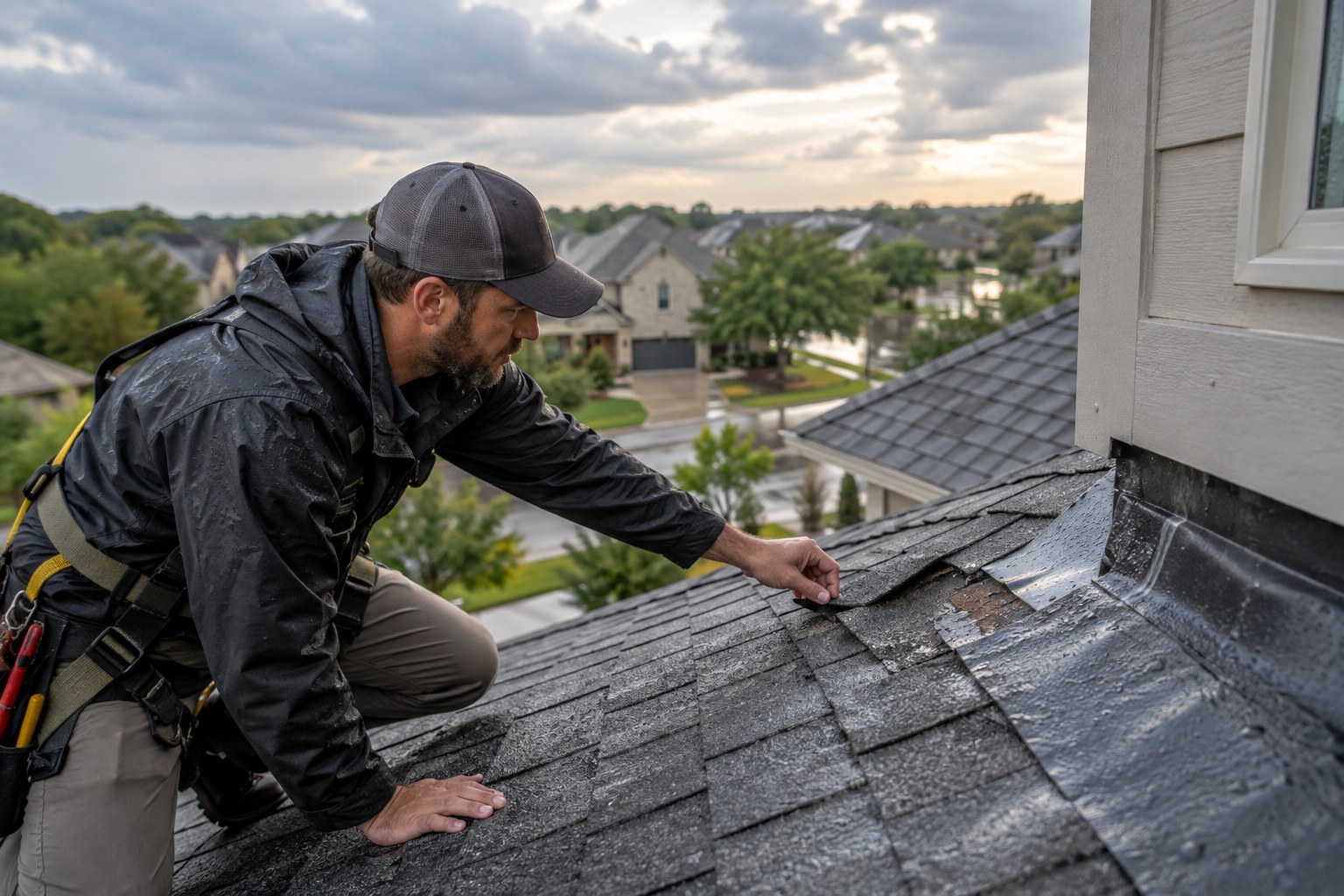
A roof leak has two costs. One is the defect itself, which on most roofs is a small, specific and inexpensive thing: a split pipe boot, a backed-out fastener, a short run of displaced flashing. The other is the damage the water does while the defect goes unaddressed, and that cost grows for as long as the leak runs.
In an occupied house those two costs stay close together, because somebody sees the stain within a day. Across Washington County a great deal of roof area sits over buildings nobody is standing in: hay barns, equipment sheds, workshops, unused wings of older houses, and guest properties used intermittently rather than lived in.
Over a season, water entering through one failed detail can saturate decking or purlins, soak insulation that will not dry on its own, reach framing, and damage anything stored beneath. None of that would have happened had the same defect occurred above an occupied kitchen. This is the strongest argument for scheduled inspection on a rural property: the roof is not more fragile, it is just less observed.
The components that fail first on a roof in this climate are almost never the roof covering. They are the rubber, plastic and sealant parts around its edges and penetrations, and they fail because they have a much shorter tolerance for heat and ultraviolet exposure than the shingle or panel they sit in.
The plumbing vent boot is the standard example. Its rubber or neoprene collar sits fully exposed, hardens over successive summers, shrinks away from the pipe and eventually splits. Sealant beads at flashing terminations go the same way: they lose elasticity, then adhesion, then function. Plastic vent housings become brittle and crack.
The useful conclusion is that a roof in sound general condition can be leaking at two or three specific points, and that those points are predictable. It also means that assessing a roof by the state of its field surface will miss the things most likely to be causing a problem.
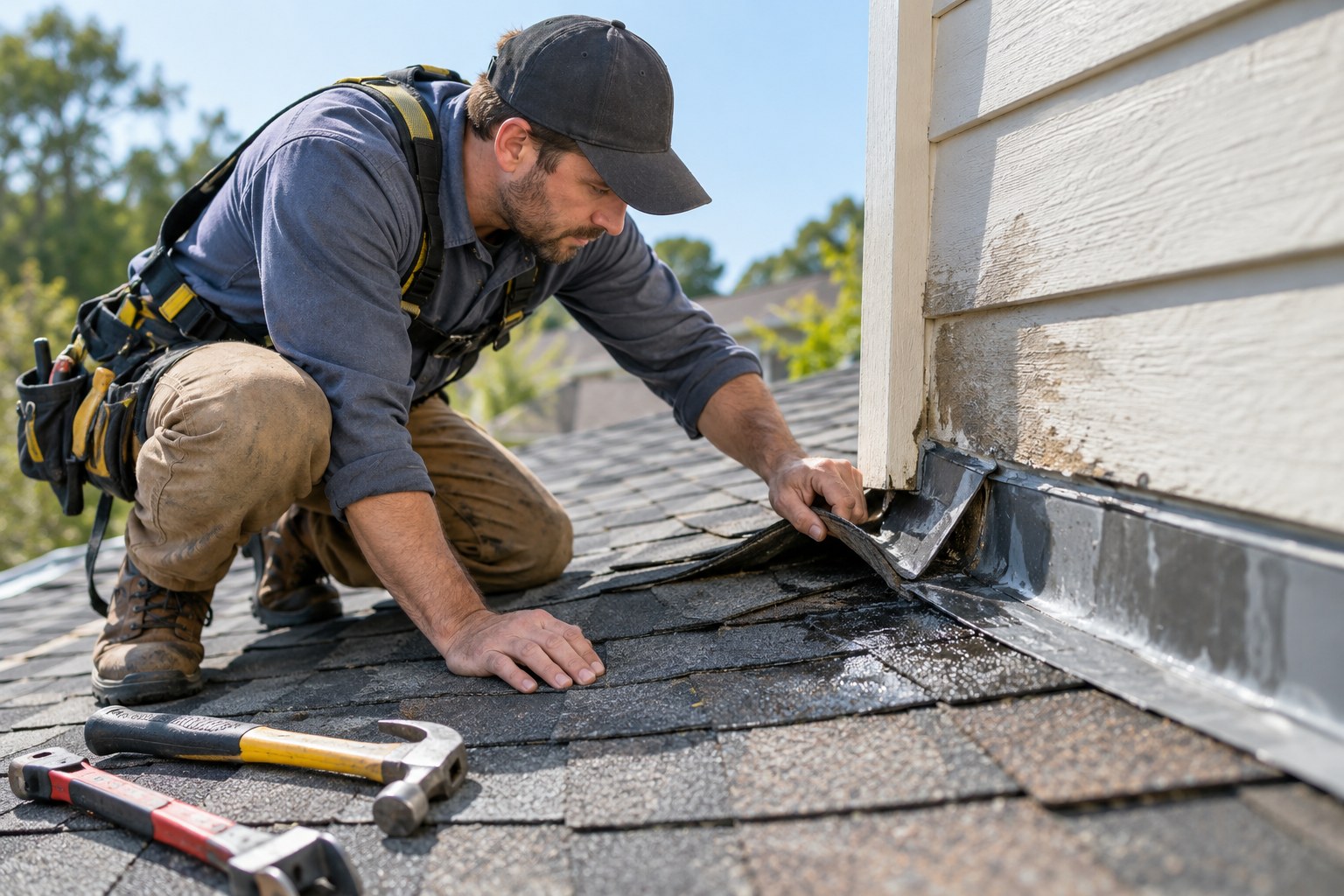
Brenham’s roof stock divides cleanly between a compact historic core and a large rural county, and the method differs accordingly.
The Brenham Downtown Historic District holds masonry commercial buildings with low-slope roofs behind parapets. Base flashing, coping, internal drainage and party-wall conditions are the priorities.
Established and newer housing within the city, with shingle and metal roofs. Penetrations, valleys and roof-to-wall flashing account for most leaks.
Farm and ranch buildings across the county: barns, equipment sheds, workshops and outbuildings, predominantly long-span metal where fasteners and laps are the recurring sources.
Where a leak has been running a long time, the question is no longer only what failed. It is also how far the water has travelled and what it has affected on the way, and that determines whether a targeted repair is sufficient.
If the defect is discrete and the surrounding roof and structure are sound, repairing that detail is the proportionate response regardless of the roof’s age. If moisture has spread through the decking or purlins, saturated insulation that will not dry, or reached framing or masonry, then the scope has to follow the moisture rather than the entry point.
On historic fabric that distinction matters more than usual. Water reaching soft lime mortar or original timber causes damage that is slower to appear and more involved to put right than the ceiling stain below it ever suggests.
Brenham is the seat of Washington County, established in 1844 and named after Richard Fox Brenham. It is served by ZIP codes 77833 and 77834, with area code 979. US 290 is the main corridor, running east–west and becoming West Main Street through the centre of town, with State Highways 36 and 105 connecting toward Bryan, Bellville and Navasota. Houston lies roughly seventy miles east and Austin around ninety miles west.
US 290 carries most of the commercial and retail frontage, and traffic on it increases noticeably during spring wildflower season. State Highway 36 and State Highway 105 connect the city into the surrounding counties.
FM 390, FM 1155 and FM 577 run through the surrounding rural area, where the farm and ranch building stock sits.
The Washington County Courthouse on East Main Street anchors the Brenham Downtown Historic District, which is listed on the National Register of Historic Places. Nearby are the Brenham Heritage Museum in the former US Post Office and Federal Building, the Brenham Fire Museum on South Market Street, and the historic cisterns at Toubin Park.
Blue Bell Creameries, established in 1907, sits on South Blue Bell Road and is the city’s best-known site. Blinn College adds institutional buildings to the inventory.
The city lies in the Post Oak Savannah region, and the surrounding county is known for its spring bluebonnets. Washington-on-the-Brazos State Historic Site is a short distance away near the community of Washington.
The Galveston Subdivision of the BNSF Railway passes through the city, part of a heritage that includes the surviving Santa Fe freight depot.
Whether a property sits in town or out in the county is the single most useful starting fact here, because it predicts both the roof type and how long a leak is likely to have been running before it was found.
The most locally relevant service for rural and intermittently occupied buildings, where scheduled checks find what nobody is there to notice. How roof leak inspection works.
For the farm, ranch and workshop buildings across Washington County, where fasteners and laps are the usual sources. How metal roof leak repair works.
For the parapet-walled buildings of the downtown historic district and the corridor commercial stock on US 290. How commercial leak repair works.
Useful on a large or rural roof where a long-running leak has spread and the entry point is no longer obvious. How roof leak detection works.
Because of how long it has been running, not because the defect was unusual. In an occupied house a leak is reported the same day. In a barn, a shop, an unused wing or a guest property between visits, the same failed fastener or split boot can admit water through dozens of rainfalls before anyone notices. The repair is the same; the damage around it is not.
By inspecting on a schedule instead of waiting for a symptom, because the symptom may not be seen for months. Periodic checks after storm season, with attention to the drainage path and the penetrations, catch the defects that would otherwise run undetected. Interior checks matter too: a stain that has dried between visits is easy to walk past.
The fasteners and their washers, the end laps between panels, and the ridge and eave closures. On a long panel run, daily thermal movement works the fasteners near the ends of the run hardest. Anything flashed through the panel — a vent, a stack, a light panel — is the next place to look.
They are mostly low-slope roofs behind parapet walls, which changes the whole inspection. The base flashing where the roof turns up the parapet, the coping capping the wall and the internal or scupper drainage carry the risk. Several of these buildings also share party walls, so water entering near a shared wall can appear in the building next door.
It shortens the life of the roof’s accessories more than the roof covering. Long hot summers with strong sun degrade rubber boots, plastic components and sealant beads well before the shingle or panel around them is finished. That is why a roof in good general condition can still be leaking at two or three small details.
Roof leak service covers Washington County and the surrounding region.
Brazos County, north-east of Brenham on State Highway 36.
Brazos County, north-east of Brenham.
Bastrop County, west of Brenham toward Austin.
Harris and Fort Bend counties, east along the US 290 corridor.
For a rural property the most useful details are the building type, roughly how long the water has been getting in, and whether anything is stored beneath the affected area.
Call Now · (844) 625-7943