
Single-ply membranes
Seams, patches, curb and drain flashing, and perimeter terminations. Punctures from foot traffic and dropped tools are a routine finding.
Addison packs an unusual amount of commercial roof area into a small town. Offices along the Dallas North Tollway, a long-established hotel and restaurant district, and an airport covering roughly half the town’s land give it a roof inventory dominated by low-slope membranes rather than shingles.
Those roofs almost never leak in the open field. They leak at the hundreds of points where equipment, drains and walls interrupt the membrane.
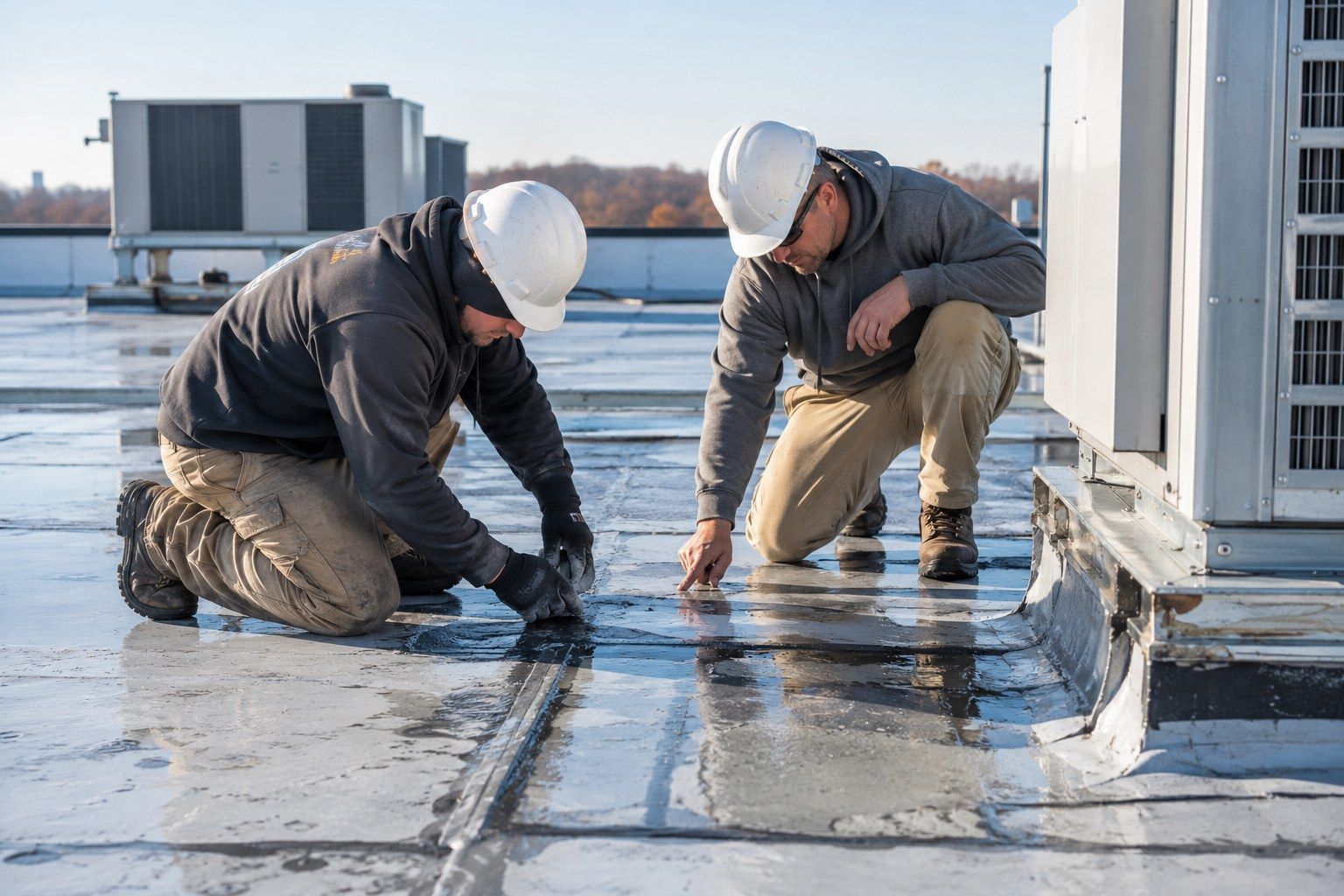
On an Addison commercial roof, the likeliest leak source is a penetration, curb, drain or wall termination — not the membrane field. Count the interruptions, not the square footage.
Addison is an incorporated town of around sixteen thousand residents in which Addison Airport covers roughly half the land area. The remainder holds a dense concentration of office buildings, more than twenty hotels and well over a hundred restaurants, so the ratio of commercial to residential roof area is unlike almost anywhere else of comparable size in Texas.
That inventory is overwhelmingly low-slope: single-ply and modified-bitumen membranes, built-up roofs, and metal on some airport and flex-industrial structures. Low-slope roofs do not shed water, they drain it, and they fail at interruptions rather than across their surfaces.
The other defining feature is rooftop mechanical density. An office building, hotel or restaurant carries a substantial plant load, and each unit means a curb, pipe and conduit penetrations, support sleepers and a service route for technicians. On a mature building that is a large number of details, each with its own history.
A rooftop mechanical unit sits on a curb, and the membrane has to turn up that curb and terminate under a counterflashing or cap. That termination is the single most productive place to look for a leak on a commercial roof, because it combines a vulnerable detail with constant disturbance.
Equipment vibrates. It is serviced, which means people and tools on the roof around it. It is replaced on a cycle shorter than the roof’s, and a replacement unit is frequently not quite the footprint of the one it succeeded, leaving modified or patched flashing behind. Condensate lines, gas piping, conduit and refrigerant lines all run from it across the roof on supports bearing directly on the membrane.
Service routes matter as much as the equipment. Where walkway pads are missing, displaced, or never covered the route technicians actually take, foot traffic lands on the membrane, and repeated traffic across insulation board joints reliably produces a puncture that leaks long before anyone notices.
The hardest part of a commercial leak is not repairing it. It is locating it, because on a low-slope roof the point where water enters and the point where it appears inside can be a long way apart.
Water that gets past the membrane travels along whatever path is available: between the membrane and the insulation, through the insulation layer, along the flutes of a metal deck, or across a suspended ceiling. On a metal deck it can run along a flute for many feet before reaching a joint and dropping through.
In a multi-tenant building this produces a predictable complication. The suite reporting water is not necessarily the suite under the breach, and more than one tenant may report the same leak. Treating the complaint as a direction rather than an address keeps the search efficient.
Addison’s commercial roofs span several generations of low-slope technology, often on the same street, and the assembly determines the method.
Seams, patches, curb and drain flashing, and perimeter terminations. Punctures from foot traffic and dropped tools are a routine finding.
Laps, flashing details and surfacing condition. Common on buildings re-roofed during the 1990s and 2000s.
Found on some older stock. Blistering, ridging and flashing condition at penetrations and walls are the priorities.
On airport-adjacent and flex buildings. Fasteners, laps, closures and penetration flashing rather than the panel field.
Addison is an incorporated town in Dallas County, served by ZIP code 75001. It sits in the Dallas North Tollway corridor between the LBJ Freeway, Interstate 635, to the south and the President George Bush Turnpike, State Highway 190, to the north. It lies roughly thirteen miles north of downtown Dallas, about sixteen miles north-east of DFW International Airport and around eleven miles north of Love Field.
Belt Line Road runs east–west through the town and carries the restaurant district. Midway Road, Marsh Lane, Addison Road, Keller Springs Road, Arapaho Road and the Dallas Parkway frontage carry the rest of the commercial frontage.
Keller Springs Road runs beneath the airport through the Addison Airport Toll Tunnel, completed in February 1999.
Addison Airport occupies about half the town’s land area, and the flex, hangar and office buildings around it on Addison Road, Dooley Road, Surveyor Boulevard and Sunbelt Drive form a distinct roof inventory.
The town is bordered by Dallas to the north, east and south, by Carrollton to the west, and by Farmers Branch to the west and south.
Addison Circle, the Addison Conference Centre and Addison Theatre Centre on Addison Road, and the Addison Athletic Club on Beltway Drive are among the recognisable local sites.
Much of the office stock sits in the Quorum and Bent Tree submarkets and dates from the late 1970s and 1980s, so most of it has been re-roofed at least once.
Addison sits a few miles west of this business’s own Richardson address, but these city pages describe service coverage rather than separate branch locations. What determines the inspection is the building’s deck, membrane, roof history and rooftop equipment load.
How a commercial leak behaves usually points toward a category of cause. The source still has to be confirmed on the roof.
| Leak behaviour | Most likely category | Where to start |
|---|---|---|
| Only in prolonged or heavy rain | Drainage capacity, or ponding over a marginal detail | Drains, scuppers, low spots and the seams within them |
| Every rainfall, consistent location | A discrete breach: puncture, open seam or failed curb flashing | Penetrations, curbs and service walkway routes upslope |
| Multiple suites on the same floor | Lateral travel along a deck flute or through insulation | Deck span direction, then the nearest shared penetration |
The core local service, covering office, hospitality, retail and restaurant buildings across the town. How commercial leak repair works.
For drainage, ponding, seams and curb flashing on low-slope membranes. How flat roof leak repair works.
The most useful service in a multi-tenant building, where the reporting suite and the breach are often far apart. How roof leak detection works.
For North Texas hail and wind events, where membrane bruising and lifted edge metal rarely show from the ground. How storm damage repair works.
Often not. On a low-slope commercial roof, water entering at one point can travel between the membrane and the deck, through the insulation layer, or along a structural deck flute for a considerable distance before it finds a way down. On a multi-tenant floor it regularly presents in a different suite from the one under the breach, which is why the tenant reporting the problem is a starting point rather than a location.
Because that is where the roof has been interrupted most. An office or restaurant roof may carry packaged units, condensers, exhaust fans, grease ducts, conduit and pipe supports, each a curb or penetration flashed through the membrane. Equipment also vibrates, gets serviced by people walking on the roof, and is replaced on a shorter cycle than the roof itself.
Both matter, and they interact. Much of Addison’s office stock dates from the late 1970s and 1980s, so many roofs have been recovered or replaced at least once. What matters is how many times, whether the previous assembly was removed or built over, and whether moisture was trapped in the process. Roof history is often more informative than roof age.
It is a protective pad or path laid over the membrane along the routes technicians use to reach rooftop equipment. Where one is missing or has been moved, foot traffic goes directly onto the membrane, and repeated traffic over insulation board joints readily produces punctures that leak without being obvious.
Yes, though differently from a shingle roof. Hail can bruise or fracture a membrane, damage the surfacing on a modified-bitumen system, crush insulation beneath the membrane, and dent metal edge and coping. Much of that leaves little trace from the ground and may not leak immediately, so condition is best assessed after the event rather than after the leak.
In two ways worth knowing. Grease-laden exhaust can degrade a membrane around the duct, and the concentration of kitchen exhaust and make-up air equipment puts an unusually high number of penetrations into a small roof area.
A failed curb flashing, an open seam, a puncture on a service route or a displaced drain flashing can be repaired on an otherwise serviceable membrane — which, on a building with a substantial equipment load, describes a large share of leaks.
The case for broader work strengthens when seams are failing in multiple areas, when the membrane has reached the end of its service life, when insulation is saturated over a wide area, or when the roof has been built over repeatedly and moisture is trapped in an older assembly beneath. Those are findings from the roof, not inferences from its age.
Roof leak service covers Addison and the surrounding Dallas–Fort Worth metroplex.
Dallas County, immediately west and south of Addison.
Dallas County, immediately west of Addison.
Dallas County, east of Addison along the President George Bush Turnpike.
Dallas County, about thirteen miles south of Addison.
The most useful details are the building type, the deck if known, whether more than one suite is affected, and whether any rooftop equipment has been serviced recently.
Call Now · (844) 625-7943